
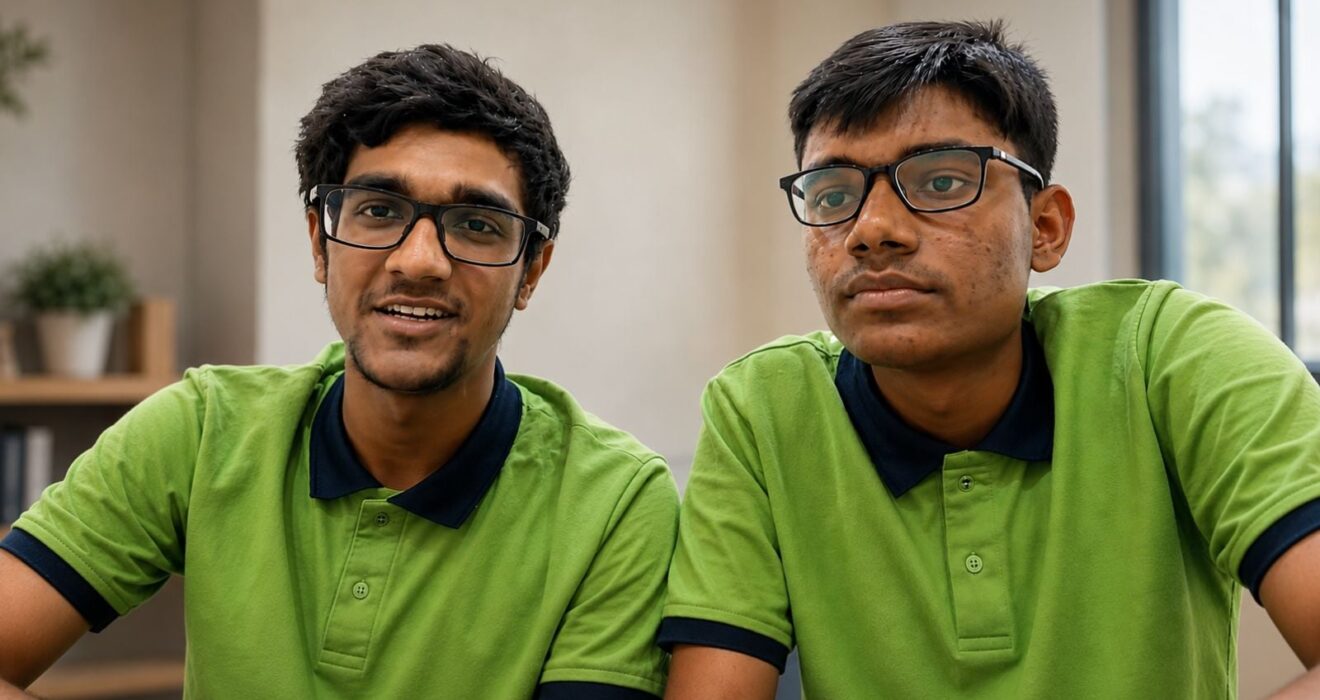
Kota hostel mates grab AIR 1 and 2 in JEE Advanced 2026, but their views on AI coud not be more different | Education News
In what may be the most quietly dramatic detail of this year’s result season, the two are hostel mates who spent years studying side by side in Allen, in Kota. Indianexpress.com spoke with both toppers for a conversation on their preparation journeys, the mistakes they’d undo, their thoughts on AI, things they’d change in the Joint Entrance Examination (JEE) for the better, and why toppers opt for Computer Science at IIT Bombay.
Q. How did you perform in Class 12 board examinations? Are you both from the CBSE board?
Kabeer Chhillar: We are both from CBSE. I got 97.2%.
Shubham Kumar: And I got 97%.
Q. There has been considerable discussion around moderation and OSM-related concerns this year. Did either of you face such issues?
Shubham Kumar: No, we did not face the issues of OSM, which unfortunately many students are facing.
Kabeer Chhillar: Well, none of us really cared about our board marks. We didn’t really look at it. The day the result came out, we checked it, and that was it. My primary focus was JEE.
Q. When did your JEE preparation actually begin?
Story continues below this ad
Shubham Kumar: My formal preparation started in Class 11 when I joined coaching. Before that, since Class 10, I used to read theory books, especially in Physics, like HC Verma, NCERT, and books by some foreign authors. But formal preparation, coaching material, solving problems, and balancing all three subjects started in Class 11.
Kabeer Chhillar: I started in Class 9 in Delhi, and then came to Kota in Class 11.
Q. How many hours did you typically study during your preparation?
Kabeer Chhillar: For most days, our teachers had given us a fixed programme that we had to follow. Our primary focus was completing that task. If there had been extra time, I would have revised areas where I felt weak. Towards the end, I was primarily studying chemistry. I was studying around 12 hours a day near the exam, but for most of the preparation, it was around 8 – 10 hours.
Story continues below this ad
Shubham Kumar: It was almost similar for me. Around 9 – 10 hours every day along with classes. During the exam period, the hours increased because of the pressure. I studied almost the entire day, except for playing around 20 – 30 minutes in the evening.
Q. How did you deal with stress during preparation?
Kabeer Chhillar: I had never played table tennis before coming here. We had a table tennis table and played a lot in Class 11 and 12. We also played random games and spent some time running around in the evenings.
Shubham Kumar: For me, it was badminton or cricket with friends in the evening. That was my major hobby during preparation.
Q. Did you develop any interests beyond academics during these years?
Story continues below this ad
Kabeer Chhillar: One hobby I discovered was listening to music. Before JEE preparation, I rarely listened to music. During preparation, I started listening to it to some extent.
Q. What role did social media play in your preparation?
Kabeer Chhillar: I didn’t use what people generally consider social media, like Snapchat or Instagram. I mainly used WhatsApp to talk to teachers, friends, and parents.
Shubham Kumar: Mostly the same for me. I used WhatsApp to connect with family and friends. I also spent around 15 – 20 minutes a day on YouTube Shorts, mainly for news and sports updates.
Story continues below this ad
Q. AI has become increasingly common among students. Did you use AI tools during your preparation?
Shubham Kumar: I used AI tools like Claude and NotebookLM almost every day. I uploaded PDFs of textbooks and coaching materials to NotebookLM and created quizzes or summaries for quick revision.
I also used Claude and sometimes Gemini to organise coaching material into clean PDFs and question papers. Sometimes I even created computer-based tests from raw questions so that I could attempt them in an actual examination format.
Kabeer Chhillar: I didn’t do any of this. I never used AI.
Story continues below this ad
Q. Looking back, what mistakes would you avoid if you had another chance?
Kabeer Chhillar: I would spend more time revising theory and notes and less time solving questions.
Shubham Kumar: We often think some tasks are only a matter of minutes and end up procrastinating. During the exam, those small delays can make a big difference. If I had avoided procrastination, the journey would have been smoother.
Q. How did you balance board examinations and JEE preparation?
Story continues below this ad
Shubham Kumar: During boards, we just had to revise all the topics we had already studied for JEE, but in a way recognised by NCERT and CBSE. We practised frequently asked numericals, definitions and question types. A day or two of revision was sufficient.
Kabeer Chhillar: For Maths, there is a chapter called LPP that is in the boards but not in JEE, so I studied that. In Physics, there are some topics and diagrams that people don’t focus on during JEE preparation but are important for boards. I revised NCERT and looked at all those diagrams. For English and IP, I had to study separately.
Q. Does preparing for JEE automatically help with board examinations?
Shubham Kumar: If we are preparing for JEE, then we are preparing for boards too. It only takes two or three days to revise the syllabus differently for board exams.
Story continues below this ad
Q. How would you rate the difficulty level of JEE Main and JEE Advanced this year?
Kabeer Chhillar: JEE Main was more difficult than expected and more difficult than previous years.
Shubham Kumar: The Main examination was comparatively more difficult and lengthier than last year. But we had already practised papers that were even more difficult.
Q. What did you do when you got stuck on a difficult question during the exam?
Shubham Kumar: I would read the question again to see if I had missed any important information. If I still couldn’t solve it, I would mark it for review and return to it later.
Kabeer Chhillar: You shouldn’t hesitate to leave a question for later. Spending too much time on one question only wastes time. You have to move on quickly.
Q. Is it better to isolate yourself during preparation or stay socially connected?
Shubham Kumar: I think students should follow an intermediate path. There were times when I stayed isolated to focus on self-study, but I also spent time with friends.
Kabeer Chhillar: Yes, I think an intermediate path is the best approach.
Q. You studied under the same teachers and stayed in the same hostel. How important was peer interaction?
Kabeer Chhillar: I always preferred studying alone.
Shubham Kumar: I used to observe what others were doing, but ultimately I followed my own judgement. Taking ideas from others and blending them with my own strategy helped me create better approaches.
Q. When mock test results exposed weaknesses, what was your priority: concept revision or question practice?
Kabeer Chhillar: Practice. Understanding concepts is important, but if I repeatedly got questions wrong on a topic, I preferred solving more questions rather than revising notes.
Shubham Kumar: During examinations, it is important to focus on attempting questions. You score marks for solving questions, not for what you already know. Attempting as many questions as possible while maintaining accuracy is the key.
Q. What are your preferred choices for college and branch?
Both Shubham Kumar and Kabeer Chhillar: IIT Bombay, Computer Science.
Q. Why IIT Bombay and why Computer Science?
Kabeer Chhillar: The most important factor is the peer group. IIT Bombay is not just about faculty. The best students go there, and future generations know that the best students go there. Being surrounded by people like you and like-minded people matters the most.
Shubham Kumar: Computer Science and Engineering offers opportunities in software and technology, which is one of the leading sectors in the world today. IIT Bombay also provides an excellent peer group where top students from across India come together.
Q. Kabeer, you have spoken about your interest in astronomy. Why choose Computer Science instead?
Kabeer Chhillar: I really want to pursue astronomy. But Computer Science is extremely important in astronomy as well. You have to program and control systems. Nowadays, AI is even more important. So Computer Science complements that interest.
Q. Do you see yourself returning to astronomy in the future?
Kabeer Chhillar: Definitely.
Q. Shubham, what are your plans after Computer Science?
Shubham Kumar: As of now, I want to go deeper into artificial intelligence and think about how it can be made more accessible, secure and safer for the world.
Q. If you could change one thing in the JEE ecosystem, what would it be?
Kabeer Chhillar: I think some practical component should be included in studies, even though I understand it may not be easy to implement.
Shubham Kumar: AI should be constructively integrated into the coaching ecosystem. Students should not misuse it simply for answers. Instead, it can be used for learning, creating quizzes, analysing papers and improving preparation methods. That could bring a significant change to the industry.