
IIT Panel Says AI Tools Used To Breach CBSE Portals, Vendor Lacked Expertise To Secure System | Education and Career News
Last Updated:
The panel was deployed by the Centre to secure the portals of the Central Board of Secondary Education (CBSE) and the OSM portals after irregularities in the system surfaced




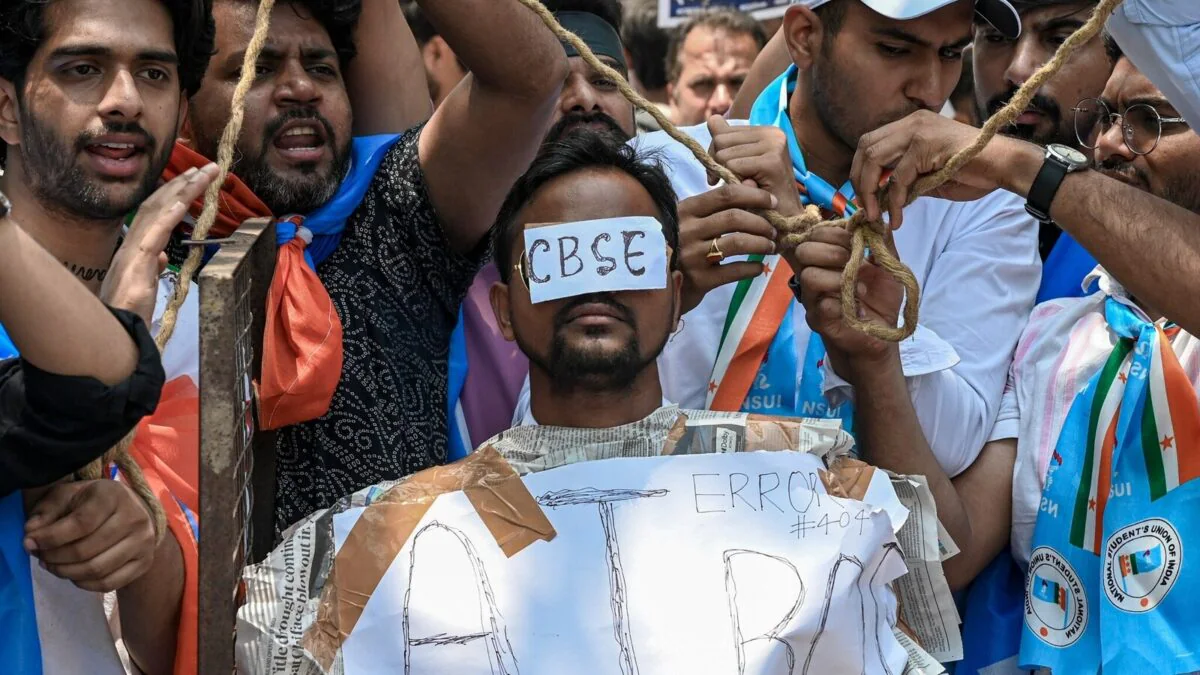
A protest outside the CBSE headquarters over the On-Screen Marking (OSM) evaluation system | File photo credit: PTI
A high-level panel, comprising experts from IIT Kanpur and Madras, has concluded that powerful Artificial Intelligence (AI) tools, mainly Anthropic’s Claude, were used to detect flaws and gain access to parts of CBSE and its On-Screen Marking (OSM) portals.
According to a report by the Economic Times, the panel was deployed by the Centre to secure the portals of the Central Board of Secondary Education (CBSE) and the OSM portals after irregularities in the system surfaced, sparking heightened concerns over the safety of crucial student data.
The panel discovered that the private vendor handling the platform — Coempt Edutech — lacked adequate expertise and understanding of security mechanism to provide for the security of the platform, according to the report.
Data linked to the CBSE’s OSM portal has now been transferred to a government-controlled segment of Amazon Web Services (AWS) India with assistance from MeitY.
A team of experts — who have been working on the system amid intensified scrutiny — reportedly played a vital role in enabling the CBSE verification and re-evaluation portal to go live on June 2 after a brief halt, the Economic Times reported.
The expert panel also reviewed other examination-related portals, including the Joint Seat Allocation Authority (JoSAA) and JEE Advanced infrastructure, identifying and assessing vulnerabilities in the system.
CERT-In, MeitY In Action
As the vulnerabilities in the CBSE and OSM portals came to light, CERT-In was asked to conduct a formal security audit of the system. At the same time, MeitY remains in coordination with both CBSE and the National Testing Agency (NTA) to prevent such incident in future.
The government doesn’t view the episode as a traditional cyberattack, believing the activity involved ethical hackers probing the system to detect weaknesses, reported the Economic Times, citing officials familiar with the matter.
What Is The Controversy?
On May 13, the CBSE declared the results of Class 12 board examinations. The overall pass percentage stood at 85.2 per cent against 88.39 per cent last year.
A section of students raised doubts over unexpectedly low marks, seeking access to their answer sheets. On May 19, the CBSE opened its portal, inviting students to access their evaluated answer sheets.
Several students flagged discrepancies in the answer-sheet viewing process, alleging the copies were blurred and some answers remained unevaluated. In some case, some students even claimed the answer sheet, which they had received, belonged to other candidates.
The complaints quickly garnered public attention on social media, with netizens calling for probe into the matter. Amid mounting criticism, the CBSE announced action against Hyderabad-based Coempt Edutech, the vendor managing the on-screen evaluation system.
On June 2, the Centre also ordered a probe into the platforms. Simultaneously, CBSE Chairman Rahul Singh and Secretary Himanshu Gupta were transferred by the Union Government.
Read More