
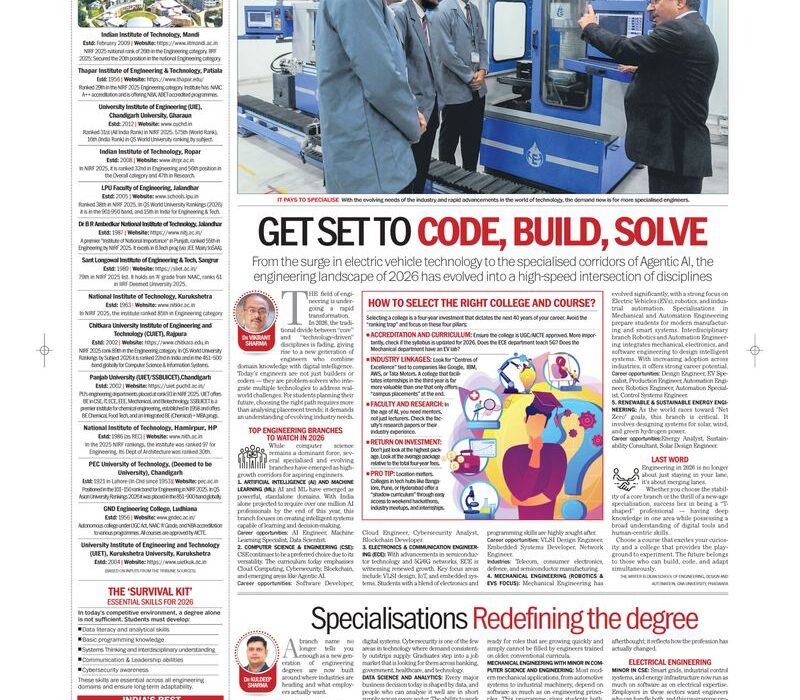
Get set to code, build, solve
From the surge in electric vehicle technology to the specialised corridors of Agentic AI, the engineering landscape of 2026 has evolved into a high-speed intersection of disciplines
The field of engineering is undergoing a rapid transformation. In 2026, the traditional divide between “core” and “technology-driven” disciplines is fading, giving rise to a new generation of engineers who combine domain knowledge with digital intelligence. Today’s engineers are not just builders or coders — they are problem-solvers who integrate multiple technologies to address real-world challenges. For students planning their future, choosing the right path requires more than analysing placement trends; it demands an understanding of evolving industry needs.
Top Engineering Branches to Watch in 2026
While computer science remains a dominant force, several specialised and evolving branches have emerged as high-growth corridors for aspiring enginners.
1. Artificial Intelligence (AI) and Machine Learning (ML): AI and ML have emerged as powerful, standalone domains. With India alone projected to require over one million AI professionals by the end of this year, this branch focuses on creating intelligent systems capable of learning and decision-making.
Career opportunities: AI Engineer, Machine Learning Specialist, Data Scientist.
2. Computer Science & Engineering (CSE): CSE continues to be a preferred choice due to its versatility. The curriculum today emphasises Cloud Computing, Cybersecurity, Blockchain, and emerging areas like Agentic AI.
Career opportunities: Software Developer, Cloud Engineer, Cybersecurity Analyst, Blockchain Developer.
3. Electronics & Communication Engineering (ECE): With advancements in semiconductor technology and 5G/6G networks, ECE is witnessing renewed growth. Key focus areas include VLSI design, IoT, and embedded systems. Students with a blend of electronics and programming skills are highly sought after.
Career opportunities: VLSI Design Engineer, Embedded Systems Developer, Network Engineer.
Industries: Telecom, consumer electronics, defence, and semiconductor manufacturing.
4. Mechanical Engineering (Robotics & EVs focus): Mechanical Engineering has evolved significantly, with a strong focus on Electric Vehicles (EVs), robotics, and industrial automation. Specialisations in Mechanical and Automation Engineering prepare students for modern manufacturing and smart systems. Interdisciplinary branch Robotics and Automation Engineering integrates mechanical, electronics, and software engineering to design intelligent systems. With increasing adoption across industries, it offers strong career potential.
Career opportunities: Design Engineer, EV Specialist, Production Engineer, Automation Engineer, Robotics Engineer, Automation Specialist, Control Systems Engineer.
5. Renewable & Sustainable Energy Engineering: As the world races toward “Net Zero” goals, this branch is critical. It involves designing systems for solar, wind, and green hydrogen power.
Career opportunities:Energy Analyst, Sustainability Consultant, Solar Design Engineer.
How to Select the Right College and Course?
Selecting a college is a four-year investment that dictates the next 40 years of your career. Avoid the “ranking trap” and focus on these four pillars:
n Accreditation and Curriculum: Ensure the college is UGC/AICTE approved. More importantly, check if the syllabus is updated for 2026. Does the ECE department teach 5G? Does the Mechanical department have an EV lab?
n Industry Linkages: Look for “Centres of Excellence” tied to companies like Google, IBM, AWS, or Tata Motors. A college that facilitates internships in the third year is far more valuable than one that only offers “campus placements” at the end.
n Faculty and Research: In the age of AI, you need mentors, not just lecturers. Check the faculty’s research papers or their industry experience.
n Return on Investment: Don’t just look at the highest package. Look at the average package relative to the total four-year fees.
n Pro Tip: Location matters. Colleges in tech hubs like Bangalore, Pune, or Hyderabad offer a “shadow curriculum” through easy access to weekend hackathons, industry meetups, and internships.
Last word
Engineering in 2026 is no longer about just staying in your lane, it’s about merging lanes.
Whether you choose the stability of a core branch or the thrill of a new-age specialisation, success lies in being a “T-shaped” professional — having deep knowledge in one area while possessing a broad understanding of digital tools and human-centric skills.
Choose a course that excites your curiosity and a college that provides the playground to experiment. The future belongs to those who can build, code, and adapt simultaneously.