
CBSE Three-Language Policy: Board Says Schools Are Ready. Parents Disagree. Here’s Why | Education and Career News
Last Updated:
47.3% of schools already offer two or more native Indian languages to Class 9 students, meaning they fully comply with the policy without requiring additional teachers, CBSE said.




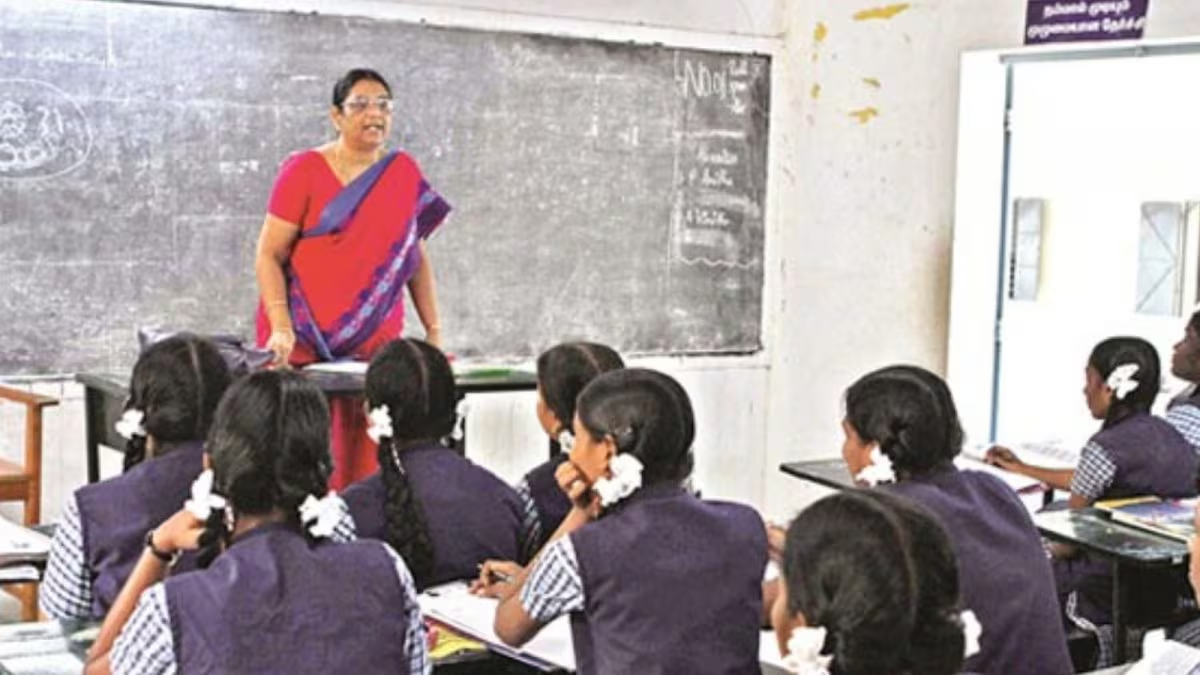
Petitioners claim many schools do not have trained language teachers or proper textbooks, making implementation difficult. (FIle Photo)
The debate over CBSE’s three-language policy continues. The Board has announced that it is compulsory for Class 9 students to study three languages including two Indian languages from July 1, 2026. Several parents have filed a petition stating the policy has created confusion and practical difficulties for students. However, CBSE says the concerns have already been addressed and that most affiliated schools are prepared to implement the new framework.
Let’s take a look at what has happened so far.
What Problems Are Parents And Students Facing?
Parents and teachers have raised several concerns over the sudden implementation of the three-language policy. The petition argues that CBSE reversed its earlier notification issued just 36 days before, which had stated that the third language would not be compulsory for Class 9 until the 2029-30 academic session, reported Indian Express.
Petitioners further claimed that many schools do not have trained language teachers or proper textbooks, making implementation difficult. They argue that CBSE has not yet introduced a clear board assessment pattern for the third language.
According to the petition, some schools may have to rely on Class 6 textbooks for Class 9 students due to the lack of study material. Parents alleges that schools may assign teachers from other subjects with only “functional proficiency” to teach the additional language. They have argued that the circular is arbitrary and violates Articles 14, 19, 21 and 21A of the Constitution.
What CBSE Said
Defending its policy before the Supreme Court, CBSE said most affiliated schools are already equipped to implement the three-language formula.
According to the Board, 47.3% of CBSE-affiliated schools already offer two or more native Indian languages to Class 9 students, meaning they fully comply with the policy without requiring additional teachers, the report added.
The board also stated that schools have been given flexible staffing arrangements as an interim measure while they build teaching capacity.
CBSE also argued that the petition has become largely unnecessary because it has already issued revised implementation guidelines on June 29 and a clarification circular on July 10, addressing many of the concerns raised by parents and teachers.
Can Students Still Study Foreign Languages?
CBSE rejected claims that foreign languages are being removed from schools.
The Board clarified that:
There is no ban on foreign languages such as French, German or Spanish.
A foreign language can continue as one of the three mandatory languages or be studied as an additional fourth language.
As a one-time relaxation, students currently studying two non-Indian languages (for example, English and French) can choose any Indian language to meet the new requirement.
What NCERT Said
NCERT informed the Supreme Court that it has already started preparing, reviewing and publishing textbooks in 22 Scheduled Languages to support the policy.
It also said that the Education Ministry has formed a High-Powered Task Force, working with CBSE, NIOS and academic experts, to speed up the development of Class 9 textbooks during the transition period.
What Happens Next?
The petition filed by parents from Delhi, Gurugram, Noida and Chennai, along with teachers, is scheduled to be heard by the Supreme Court. The Court’s decision could determine how and when the three-language policy is implemented across CBSE schools.
About the Author

A team of reporters, writers and editors brings you news, analyses and information on college and school admissions, board and competitive exams, career options, topper interviews, job notifications, …Read More
Read More