
CBSE, NEET To Irrigation And Pollution: How IITs Are Helping India Find Answers To Tough Questions | Explainers News
Last Updated:
From NEET disputes and CBSE issues to fighting pollution, improving irrigation and aiding farmers, IITs are increasingly becoming India’s go-to problem-solvers beyond academia.




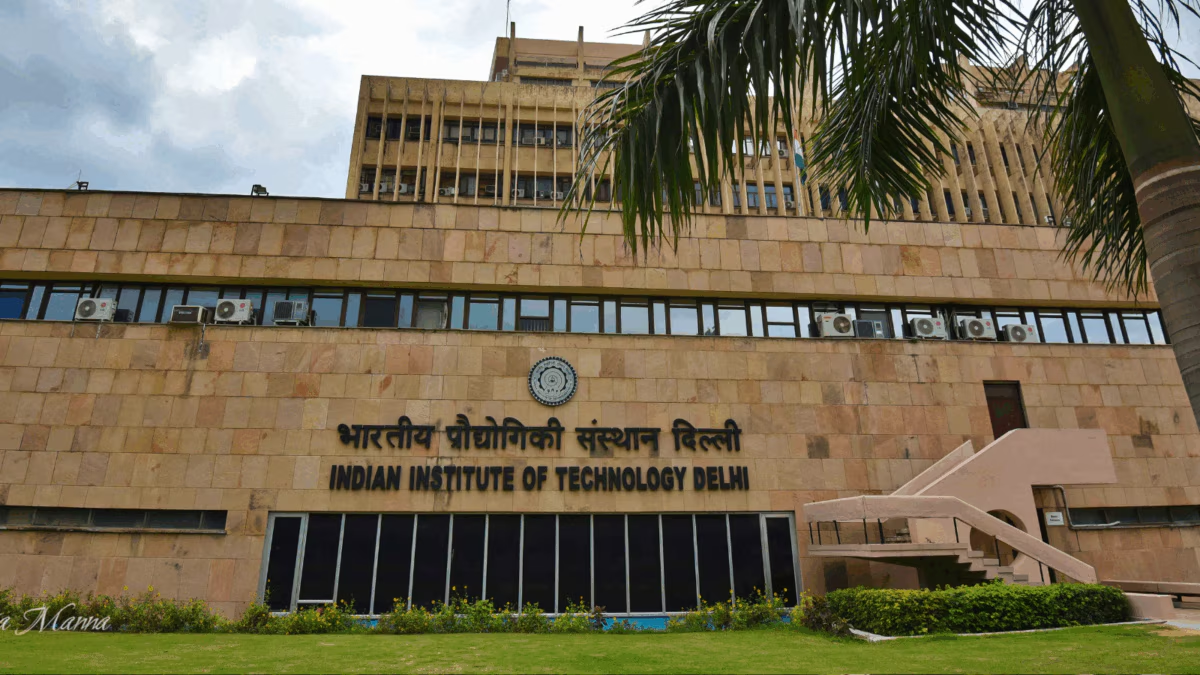
IIT-Delhi
The Central Board of Secondary Education’s (CBSE) has roped in cybersecurity experts from the Indian Institutes of Technology (IITs) to secure its OnMark digital evaluation platform. This is the latest example of a growing trend in India: when governments, regulators, courts and public institutions face technically complex challenges, they increasingly turn to IITs for answers.
The trust placed in these institutions extends far beyond engineering classrooms and research laboratories. In one of the most high-profile education controversies in recent years, the Supreme Court sought the expertise of IIT Delhi to resolve a disputed Physics question in the NEET-UG examination. The court directed the institute to constitute an expert panel to determine the scientifically correct answer, underscoring the confidence that even the judiciary places in IITs when technical issues have significant public consequences.
The expanding role of IITs today spans some of India’s most pressing challenges. They are helping secure examination systems used by millions of students, studying innovative “smog-eating” surfaces to combat Delhi’s air pollution crisis, supporting the government’s efforts to modernise agricultural extension services, and developing scientific solutions for better irrigation and water management. Increasingly, IITs are functioning not merely as centres of higher education but as problem-solving institutions for the Indian state—providing expertise, independent assessments and technology-driven solutions in areas that directly affect governance and public welfare.
Here is a look at some of the key non-academic projects and public policy initiatives where IITs are helping governments and institutions tackle difficult questions and complex challenges.
1. Securing CBSE’s OnMark Evaluation Portal
The latest example comes from CBSE’s OnMark portal, the digital platform used for on-screen evaluation of answer sheets. After vulnerabilities in the system were flagged publicly, CBSE said it had deployed cybersecurity professionals from government agencies and IITs to identify weaknesses, strengthen safeguards and move the platform to a more secure architecture. The board said the vulnerabilities had been contained and a detailed review was underway. The move underlines how IIT expertise is increasingly being used not just for innovation, but also for safeguarding critical public digital infrastructure.
2. IIT Experts Part of Parliamentary Panel On NEET Row
The role of IITs is not limited to technology. A 31-member Parliamentary Standing Committee on education, women, children, youth and sports has called National Testing Agency, the education ministry and the Union health ministry for a meeting to discuss pen-and-paper examinations versus computer-based testing (CBT). The top parliament panel will meet and discuss issues faced by students related to NEET 2026 being cancelled, the reNEET 2026 and the paper leak controversy. The meetings will focus on big NEET exam updates and recent CBSE marking errors. To fix NTA NEET and CBSE issues, a four-member expert team from IIT-Madras and IIT-Kanpur is now helping the board.
In 2024 too, during the controversy surrounding a disputed Physics question in the NEET-UG examination, the Supreme Court turned to IIT Delhi for an independent scientific assessment. The court directed IIT Delhi to constitute an expert panel to determine the correct answer to the contentious question after petitions challenged the National Testing Agency’s decision to award marks for multiple answers. The institute’s expert opinion became a key input in the judicial scrutiny of one of India’s most important entrance examinations.
3. Delhi’s Search For ‘Smog-Eating’ Solutions
With air pollution continuing to plague the national capital, the Delhi government has partnered with IIT Madras to study whether so-called “smog-eating” surfaces can help reduce pollution levels. The project is examining photocatalytic coatings based on materials such as titanium dioxide that can potentially break down pollutants like nitrogen dioxide and volatile organic compounds. Researchers will test these coatings on roads, buildings, glass surfaces and other urban infrastructure under real-world Delhi conditions to assess their effectiveness and durability.
If successful, the findings could open the door to a new category of pollution-control interventions in urban India.
4. Helping Farmers Through Project VISTAAR
Agriculture is another area where IIT expertise is being harnessed for public welfare. IIT Madras has partnered with the Union Ministry of Agriculture and Farmers’ Welfare on Project VISTAAR (Virtually Integrated System to Access Agricultural Resources). The initiative seeks to strengthen India’s agricultural extension system through digital tools and better information delivery.
A key objective is to connect farmers with technologies and solutions developed by agricultural start-ups. The platform integrates information on thousands of agri-tech ventures and aims to help farmers access services related to crop production, marketing, supply chains and government schemes.
In a country where the last-mile delivery of agricultural knowledge remains a challenge, the project represents an attempt to bridge the gap between innovation and the farm gate.
5. IIT Roorkee And Smarter Irrigation Management
Water management has become one of India’s biggest developmental challenges, especially amid climate variability and growing demand from agriculture. To address this, IIT Roorkee has been collaborating with the Ministry of Jal Shakti on irrigation water management solutions aimed at improving efficiency and sustainability. The partnership focuses on scientific assessment, data-driven planning and better utilisation of water resources across irrigation systems.
The collaboration reflects a broader trend in which engineering institutions are being asked to contribute to policy implementation and resource management rather than merely conducting academic research.
6. National Mission for Clean Ganga (NMCG)
Several IITs, including IIT Kanpur, IIT Delhi, IIT Bombay, IIT Madras, IIT Kharagpur, IIT Guwahati and IIT Roorkee, have worked with the National Mission for Clean Ganga on river rejuvenation, wastewater treatment technologies, water quality monitoring and basin management studies. Their research and technical recommendations have supported various projects under the Namami Gange programme.
7. COVID-19 Response and Healthcare Innovation
During the COVID-19 pandemic, several IITs collaborated with government agencies to develop low-cost ventilators, diagnostic tools, contact-tracing technologies and mathematical models for disease forecasting. IIT Kanpur’s Noccarc ventilator and innovations from IIT Madras, IIT Bombay and IIT Delhi were among the technologies deployed or evaluated during the public health emergency.
8. Disaster Management and Early Warning Systems
IIT Roorkee, which hosts the National Centre for Seismology’s key academic collaborations, has long supported government efforts in earthquake engineering and disaster-resilient infrastructure. IITs have also contributed to flood forecasting models, landslide studies and risk assessment frameworks used by disaster management authorities.
9. Semiconductor and Electronics Manufacturing Initiatives
As India pushes to build a domestic semiconductor ecosystem, IITs have been working closely with the Ministry of Electronics and Information Technology (MeitY), the India Semiconductor Mission and industry partners on chip design, workforce development, research and innovation. Several IITs have also been designated as key centres for semiconductor education and advanced electronics research.
Why Governments Keep Turning To IITs
What makes IITs valuable is their ability to bring together specialists in technology, data science, environmental engineering, agriculture, public policy and management. Whether it is a disputed NEET question, a vulnerable examination portal, Delhi’s pollution crisis or the challenge of improving farm advisory services, governments increasingly see IITs as neutral, credible and technically capable institutions that can provide evidence-based solutions.
The growing list of collaborations also signals a broader shift: IITs are no longer confined to producing engineers. They are increasingly becoming problem-solving institutions for the Indian state itself.
Read More