
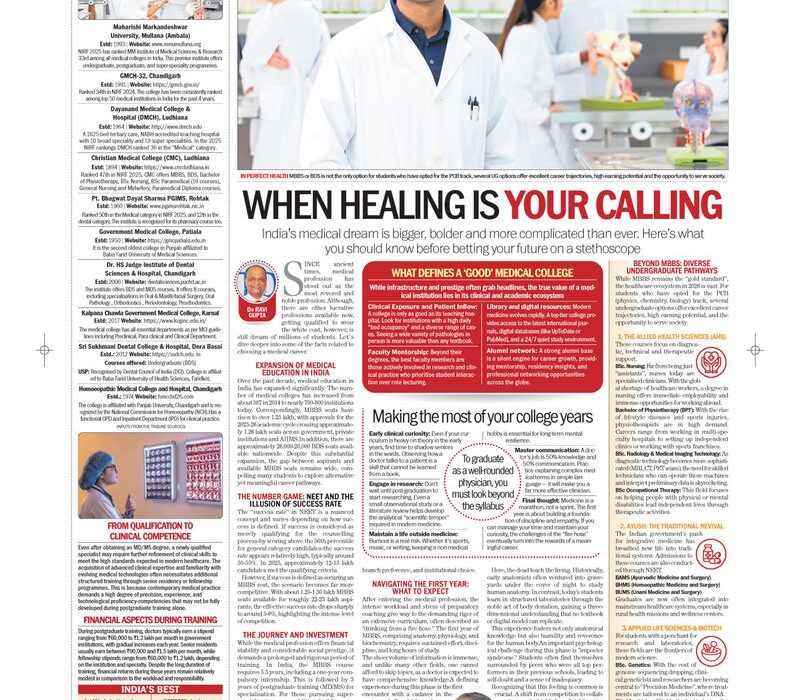
When healing is your calling
India’s medical dream is bigger, bolder and more complicated than ever. Here’s what you should know before betting your future on a stethoscope
Since ancient times, medical profession has stood out as the most revered and noble profession. Although, there are other lucrative professions available now, getting qualified to wear the white coat, however, is still dream of millions of students. Let’s dive deeper into some of the facts related to choosing a medical career.
Expansion of Medical Education in India
Over the past decade, medical education in India has expanded significantly. The number of medical colleges has increased from about 387 in 2014 to nearly 780-800 institutions today. Correspondingly, MBBS seats have risen to over 1.25 lakh, with approvals for the 2025-26 academic cycle crossing approximately 1.26 lakh seats across government, private institutions and AIIMS.In addition, there are approximately 26,000-28,000 BDS seats available nationwide. Despite this substantial expansion, the gap between aspirants and available MBBS seats remains wide, compelling many students to explore alternative yet meaningful career pathways.
The number game: nEET and the Illusion of Success Rate
The “success rate” in NEET is a nuanced concept and varies depending on how success is defined. If success is considered as merely qualifying for the counselling process-by scoring above the 50th percentile for general category candidates-the success rate appears relatively high, typically around 50-55%. In 2025, approximately 12-13 lakh candidates met the qualifying criteria.
However, if success is defined as securing an MBBS seat, the scenario becomes far more competitive. With about 1.25-1.30 lakh MBBS seats available for roughly 22-23 lakh aspirants, the effective success rate drops sharply to around 5-6%, highlighting the intense level of competition.
The Journey and Investment
While the medical profession offers financial stability and considerable social prestige, it demands a prolonged and rigorous period of training. In India, the MBBS course requires 5.5 years, including a one-year compulsory internship. This is followed by 3 years of postgraduate training (MD/MS) for specialisation. For those pursuing super-specialisation, an additional 2-3 years (DM/MCh) is required, bringing the total structured training duration to approximately 10-12 years.
Moreover, a significant bottleneck exists at the postgraduate level. Each year, approximately 70,000-75,000 PG (MD/MS/DNB) seats are available, compared to about 1.2-1.3 lakh MBBS graduates. Furthermore, fresh graduates compete with candidates from previous years who reappear for entrance examinations, further intensifying competition.
Consequently, the probability of securing a postgraduate seat in the first attempt is estimated to be around 20-30%, depending on rank, branch preference, and institutional choice.
Navigating the first year: What to expect
After entering the medical profession, the intense workload and stress of preparatory coaching give way to the demanding rigor of an extensive curriculum, often described as “drinking from a fire hose.” The first year of MBBS, comprising anatomy, physiology, and biochemistry, requires sustained effort, discipline, and long hours of study.
The sheer volume of information is immense, and unlike many other fields, one cannot afford to skip topics, as a doctor is expected to have comprehensive knowledge.A defining experience during this phase is the first encounter with a cadaver in the anatomy hall, which evokes a mixture of curiosity, apprehension, and deep respect.
Here, the dead teach the living. Historically, early anatomists often ventured into graveyards under the cover of night to study human anatomy. In contrast, today’s students learn in structured laboratories through the noble act of body donation, gaining a three-dimensional understanding that no textbook or digital model can replicate.
This experience fosters not only anatomical knowledge but also humility and reverence for the human body.An important psychological challenge during this phase is “imposter syndrome.” Students often find themselves surrounded by peers who were all top performers in their previous schools, leading to self-doubt and a sense of inadequacy.
Recognising that this feeling is common is crucial. A shift from competition to collaboration can be highly beneficial-forming study groups helps build a support system and reinforces learning, as teaching others is one of the most effective ways to master a subject.As students progress into the second, third, and final years, their outlook evolves.
The initial overwhelm gradually gives way to confidence and clinical curiosity. With increasing patient exposure, the study of disease and its treatment becomes more meaningful. Witnessing patients recover provides a deep sense of satisfaction and reinforces the purpose behind the years of rigorous training.
From qualification to clinical competence
Even after obtaining an MD/MS degree, a newly qualified specialist may require further refinement of clinical skills to meet the high standards expected in modern healthcare. The acquisition of advanced clinical expertise and familiarity with evolving medical technologies often necessitates additional structured training through senior residency or fellowship programmes. This is because contemporary medical practice demands a high degree of precision, experience, and technological proficiency-competencies that may not be fully developed during postgraduate training alone.
Financial aspects during training
During postgraduate training, doctors typically earn a stipend ranging from Rs 60,000 to Rs 1.2 lakh per month in government institutions, with gradual increases each year. Senior residents usually earn between Rs 90,000 and Rs 1.5 lakh per month, while fellowship stipends range from Rs 60,000 to Rs 1.2 lakh, depending on the institution and specialty. Despite the long duration of training, financial returns during these years remain relatively modest in comparison to the workload and responsibility.