
Reciting Mantras A Part Of Formal Education In Chhattisgarh? Order Sparks Debate | Exclusive | Education and Career News
Last Updated:
A government official said the circular was part of a broader initiative to promote patriotism, discipline, moral values, intellectual development, and awareness of Indian culture.


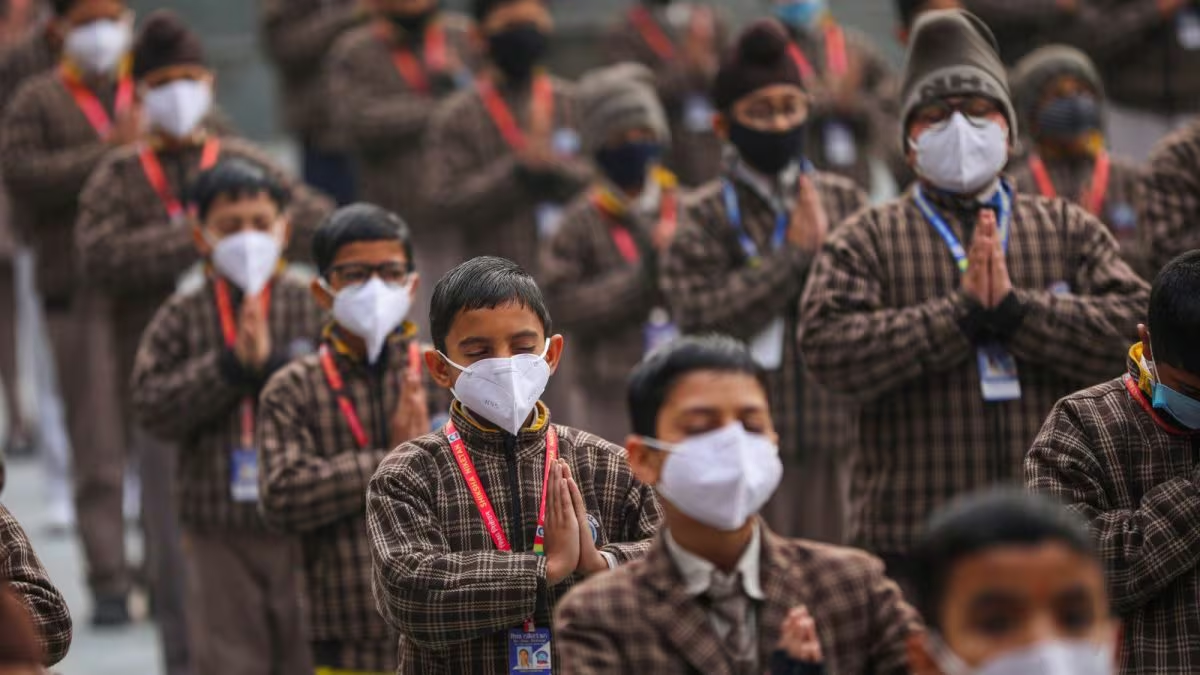
The order also required schools to conduct a series of daily cultural, educational, and value-based activities at different times during the school day. (Representative image/PTI)
Schools are set to reopen on June 16 following the summer holidays. Amidst this, the School Education Department has issued directives for the 2026–27 academic session. According to the order, a prayer session will be held upon reopening; a mealtime mantra will be recited in the afternoon, and the “Gayatri Mantra” will be recited at the time of dismissal. Emphasis has also been placed on the ‘School Entry Festival’ (Shala Pravesh Utsav), welcoming students with a “tilak”, enrolment drives, the distribution of free books, uniforms, and bicycles, and bringing dropout children back to school.
As soon as the order was released, the opposition targeted the government. Congress alleges that government schools do not belong to any single ideology or religious identity and are attended by children from all communities; therefore, making the recitation of religious mantras mandatory is inappropriate.
The government order was issued to all districts by the School Education Department on June 12 and directed DEOs to ensure strict implementation of the order including School inspections that will be conducted, and administrative action may be taken against managements or principals found violating the guidelines. The order also required schools to conduct a series of daily cultural, educational, and value-based activities at different times during the school day.
A government official said the circular was part of a broader initiative to promote patriotism, discipline, moral values, intellectual development, and awareness of Indian culture and traditions among students.
A government order issued ahead of the new academic session in Chhattisgarh has sparked a major political controversy. The School Education Department has directed that mantras be recited in government schools: “Saraswati Vandana” and other prayers in the morning, a mealtime mantra in the afternoon, and the “Gayatri Mantra” at dismissal. The government links this to Indian culture, discipline, and values, whereas the opposition claims it is an attempt to impose a political agenda on government schools.
The State opposition, while reacting sharply on it has called this move ‘problematic’ while linking the imposition with the RSS ideology. “We have school students in Schools that are mandated to sing National Anthem, but what really makes the government push the recitation of 3 different mantras in school if not imposing the RSS mindset in our education system. This move is highly polarising as in state schools, children belonging to every community seek education, it is only imposing your (BJP) political agenda in Schools while not children and families from every community will be accepting of this.”
Meanwhile, the state government maintains that this is not an agenda specific to any religion but is part of Indian culture, discipline, and value-based education. The government claims that this will foster positivity and instil traditional values in children. Chhattisgarh Deputy Chief Minister Arun Sao said, “The dropout rate has declined since the BJP government took office. Officials have been instructed to place special emphasis on parent-teacher meetings and the rationalization of schools. Student performance has improved this time around.”
However, the directive regarding the chanting of mantras in Chhattisgarh’s schools has sparked more political heat than educational debate. While the government links the move to Indian culture, discipline, and traditional values, the opposition views it as an attempt to impose an ideology on the state education system. It remains to be seen whether this initiative becomes a means for the children’s development or merely a new subject of political contention.
About the Author

Simran Babbar is a Senior Correspondent at CNN-News18, covering key developments in emerging sectors related to education and investigations. Through her reports, she brings significant updates from t…Read More
Read More