
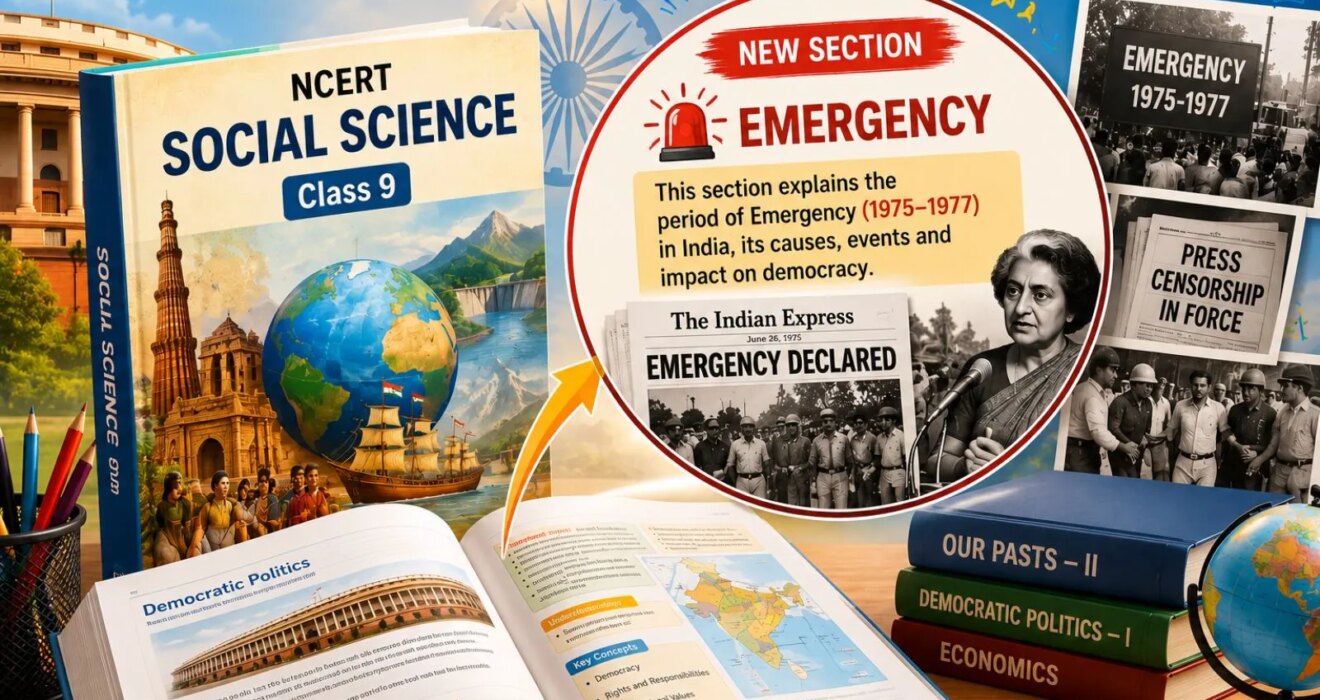
NCERT introduces a section on Emergency in the Class 9 textbook
For the first time, the 1975-77 Emergency — one of the most turbulent episodes in post-Independence Indian history — finds a place in a Class 9 Social Science textbook, with NCERT framing it as one of the major challenges that Indian democracy had to endure and survive.
The new Social Science textbook, Understanding Society: India and Beyond, introduces the Emergency episode into the secondary school curriculum for the first time, as per news agency ANI. An official speaking with the Agency stated that the earlier Class 9 textbook had no mention of the Emergency, but, as a part of the revised curriculum, a dedicated section has been added.
Read | NCERT to restore nude Mohenjo-daro ‘Dancing Girl’ image in Class 9 Arts textbook: Express Impact
Interestingly, India has recently crossed the 50-year mark since the Emergency was declared in 1975.
The chapter situates the Emergency within a broader examination of democratic strengths and vulnerabilities, treating it not as an isolated historical aberration but as a test of India’s constitutional framework. The book draws a direct line from the political discontent of the early 1970s — marked by economic hardship, joblessness, and growing disillusionment with the Indira Gandhi-led government — to the events that followed.
Speaking to reporters, Pradhan said, “NCERT has done the right thing. Future generations should know and understand the dark deeds of the Emergency so that such a situation does not arise again. That is why NCERT brought it to the forefront. NCERT did a good job.” The BJP also backed the decision, saying the “dark chapter” in India’s constitutional history must be remembered to ensure it is never repeated.
What does the section add about Emergency?
“One of the major challenges to democracy in India was recorded when an Emergency was imposed in 1975-77. In the early 1970s, public dissatisfaction with the government led by Indira Gandhi was growing. Rising unemployment, inflation, and allegations of misgovernance led to widespread protests,” the section reads.
Story continues below this ad
“In June 1975, a National Emergency was imposed by the government on the grounds of internal disturbance. During this period, a majority of Fundamental Rights were suspended, the press was censored, and numerous political leaders and activists were arrested. Democratic institutions came under severe strain, and citizens’ freedom was restricted,” it added.
Among the new chapter’s more notable choices is the prominence given to Jayaprakash Narayan, the veteran socialist leader widely known as Lok Nayak.
“Mass movements led by Jayaprakash Narayan — a political leader and socialist thinker, popularly known as Lok Nayak — mobilised students and citizens, especially in Bihar and Gujarat. The Emergency was lifted in 1977, and general elections were held, allowing people to express their will through the ballot. The defeat of the ruling government demonstrated the strength of Indian democracy and highlighted the importance of Democracy,” the book states.
Rather than treating the Emergency as the chapter’s sole preoccupation, NCERT has woven it into a wider conversation about what threatens democratic systems today. School students reading this chapter will find the Emergency placed in company with fake news, misinformation, destruction of public property, poverty, regionalism, caste discrimination and gender inequality.
Story continues below this ad
Democracy and You
A newly added section, “Democracy and You”, aims to make students active participants in this conversation. Described by NCERT as a first-time inclusion, it is designed to bridge the gap between abstract constitutional principles and the lived experience of young citizens navigating an increasingly complex public sphere.
The new textbook’s ambitions extend well beyond the Emergency. It traces the roots of democratic practice in India to ancient periods and charts the evolution of constitutional institutions.
The media, described in the book as the “fourth pillar of democracy”, receives a dedicated section, with the textbook emphasising its role in holding power to account and channelling public grievance into democratic discourse.
According to BJP spokesperson Shehzad Poonawalla, June 25, 1975, marked the darkest chapter of India’s democratic and constitutional journey, and he alleged that the Congress had attacked every constitutional institution during the period.
Story continues below this ad
“The Emergency was imposed out of lust for power by Indira Gandhi and the Congress. Every constitutional body was attacked. Parliament, the legislature, the judiciary and the media were censored and suppressed. “We saw how even the likes of Kishore Kumar had their voice suppressed and their songs removed from All India Radio. These were the kind of atrocities that were committed,” he said in a video statement.
He said fundamental rights were suspended, judicial review taken away, and constitutional safeguards dismantled. The NCERT’s decision to include a chapter on the Emergency will help students learn about this period so that such events are never repeated, he said. Attacking the Congress, he alleged that the party continues to have an “Emergency mindset” and questioned why it is opposing the inclusion of the chapter.
Poonawalla said leaders such as Jayaprakash Narayan, Mulayam Singh Yadav and Lalu Prasad Yadav had fought against the Emergency and alleged that it is ironic that many parties associated with them are now aligned with the Congress.
Teaching of emergency in the school curriculum has been a subject of debate in previous years.
While there were complaints before that school textbooks are yet to reflect the full excesses of the Emergency, several passages about the dark period got pruned as late as 2023 under the BJP as part of a curriculum rationalisation exercise following the pandemic.
Story continues below this ad
The deleted content included paragraphs on controversies surrounding the decision to impose the Emergency, and the abuse of power and malpractices committed by the Indira Gandhi government.
In 2018, the then-HRD Minister Prakash Javadekar had alleged that the textbooks did not reflect the “whole story” of the Emergency in school curricula for students to understand the reality of the time.
“In our textbooks, there are some chapters and columns on the Emergency that will be reviewed and this black chapter and assault on democracy of the country will figure more in the books…” “We will include the whole story of Emergency in the curriculum. Children should know the reality of that time. That is why the Emergency period is considered to be the second freedom struggle,” he had said.
(with PTI inputs)