
Mother and son, 45 and 21, collected their IIT Madras degrees on the same stage | Education News
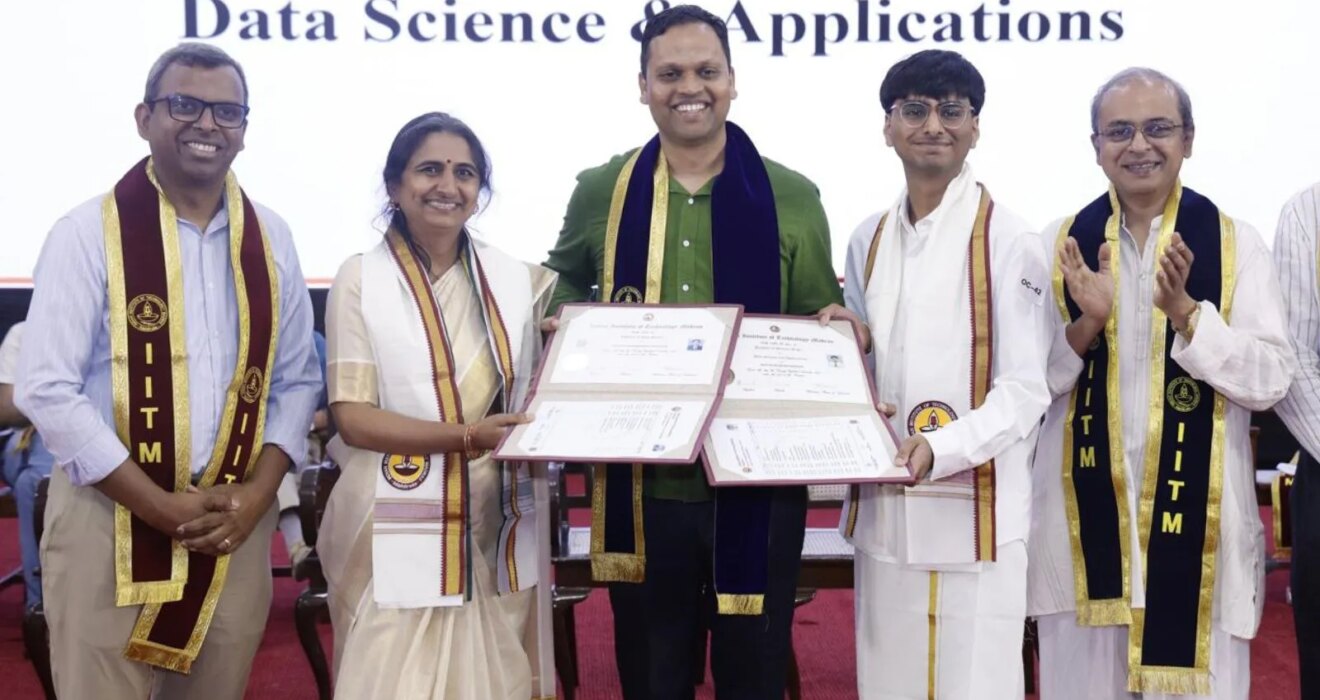
At IIT Madras’s recent convocation, Jigisha Tailor and her son Aditya Kapadia walked on stage together. She is 45. He is 21; both shared the same degree, but neither had planned it that way.
Jigisha had spent 16 years teaching electronics at an engineering college in Bharuch, Gujarat. In 2019, family responsibilities pulled her out of the classroom. Three years later, she walked back into one, this time as a student, in a course her son had talked her into.
Aditya Kapadia was 18 when he enrolled in IIT Madras’s online BS in Data Science and Applications in 2021. The Covid pandemic shut every campus in the country. “It was Covid time when I was entering college,” he says. “So if I did a regular course from any IIT, or even MIT or Stanford, it would have been online only.” Data science pulled him in on its own merit. “I was excited about data science and AI. I found it interesting,” he adds.
He started the course alongside a diploma at a college in Ahmedabad, a rule at the time that also required online students to be enrolled somewhere in person. That changed when IIT Madras’s senate declared the degree equivalent to a regular four-year course. “I dropped out of that college and continued here,” Aditya says.
Jigisha watched from the sidelines at first. The coursework spilled across the kitchen table: statistics, systems, a vocabulary close enough to her own electronics background to feel familiar, far enough to feel new. Aditya kept pushing her to sign up. Towards the end of 2022, she did eventually join.
Read | In Kota, a mother learnt physics and math to keep her son’s IIT dream alive
Restarting was harder than she expected. “Initially, it was like after a long period of time, I was learning once again the maths and stats,” she says. “That was a little bit difficult to grasp. After two to three weeks, it was easy.” She leaned on the institute’s live doubt-clearing sessions, some running past midnight, and on a WhatsApp group her batchmates had formed. She kept her course load deliberately light, one or two subjects a semester, never four like Aditya. “That’s the beauty of this programme,” he says. “If you’re a working professional, or someone like my mother, you can go at a gradual pace.”
Story continues below this ad
The days folded around each other: lectures, assignments, housework. “I used to wake up around 4:30 am, and finish my studying by seven,” Jigisha says. Chores came next. Then more coursework by early afternoon.
Not everyone understood why she was doing it. “Many of our relatives would say, ‘Why are you studying now? Why do you want a job?” she says. “I would tell them that I want to do something different.”
At home, nobody asked that question. Her husband, also a college professor, pushed her through the low points. “There was a phase when I started feeling the pressure,” she says. “If I failed or dropped the course, what impact would that have on my children? But my husband used to motivate me and back me up.”
Her father-in-law checked in on her project deadlines. Her mother-in-law, confined to a wheelchair by then, would ask her why she was putting herself through so much. “It was their support that made it possible,” Jigisha says.
Story continues below this ad
Somewhere in the routine, mother and son turned into study partners, and then competitors. “There was a sense of competition, like who would score an A or an S,” Aditya says. An ‘S’ grade is the highest distinction, typically awarded to the top 5–10% of students, while an ‘A’ grade denotes high distinction and ranks below ‘S’ but above ‘B’.
When Jigisha scored an S in one course, he wanted one too. When he got his, she pushed harder to match it. He had a head start, having cleared his diploma subjects earlier, and used it to walk her through what came next, how the viva panels worked, and what to expect from the online proctored exams. “His experience helped me a lot,” she says.
Aditya finished his BS in 2024 and interned at Syngenta as a data science intern before being offered a full-time role. Jigisha finished around the same time, but chose to pause before job-hunting; her younger son is now in Class 12, and she wanted the time to see him through it. Teaching hasn’t left her mind, though. Her husband has floated the idea of guest lectures at his college. “I now have a different background with me,” she says. “I think I can teach even better now.”
The moment that stayed with both of them came at convocation, when they were called on stage together to collect their degrees, a diploma for her, a BS for him, arranged quietly after a batchmate heard their story at a pre-convocation dinner. Neither of them had planned it. They hadn’t even sat together that morning; BS and diploma students were seated in separate sections. “It felt like a miracle,” Jigisha says.
Story continues below this ad
Aditya watched his mother study the way she once watched him. “I saw her routine, and I was inspired. This is how you study, this is how you work hard,” he says. It changed something between them, beyond the degree itself. “We spent a lot more time together,” he says. “I got to see a younger version of my mother, the one who was still learning.”
(with inputs from Sagarika Rastogi, an intern with the Indianexpress.com)