
JEE Advanced 2026: For the first time, over 10,000 girls qualify for IITs, highest pass rate on record | Education News
4 min readMumbaiJun 2, 2026 07:00 AM IST
For the first time, more than 10,000 women have qualified for admission to Indian Institutes of Technology (IITs), with nearly one in four female candidates clearing JEE-Advanced 2026 — their highest pass rate on record, according to data analysed by The Indian Express.
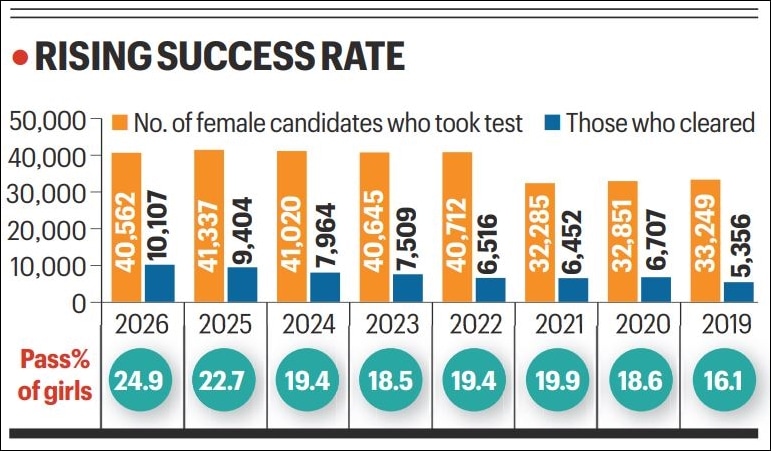
The data shows that the number of women qualifying for IITs has jumped nearly 89 per cent, from 5,356 to 10,107, since 2019 — after a supernumerary seats scheme to improve their representation in IITs took effect. Over the same period, the number of women appearing for the exam rose by about 22 per cent, from 33,249 to 40,562.
As the results of JEE Advanced 2026 were declared Monday, 24.9 per cent of the 40,562 women candidates, who appeared, cleared the exam. Overall, around 56,000 candidates qualified and made it to the common rank list.
Making it to the JEE Advanced rank list does not guarantee a seat in an IIT — the 23 institutes together offer about 20,000 seats. But those who do not make it into an IIT are still eligible for admission to other premier institutions and are likely to secure a seat at a National Institute of Technology (NIT) or an Indian Institute of Information Technology (IIIT).
Speaking to The Indian Express, experts described the 10,000-mark as a milestone for gender representation in STEM education, which reflects the growing participation of women in premier engineering institutions after the seats scheme was introduced in 2018. Under the scheme, additional seats were created exclusively for female candidates, with the aim of raising female enrolment to 20 per cent within five years.
Since then, the success rate among girls in JEE-Advanced has steadily increased. In 2018, only 13.47 per cent of girls who appeared qualified for IIT admissions. That figure has now risen to nearly 25 per cent.
Prof Shalabh of IIT Kanpur, who was the organising chairman of JEE-Advanced 2018, said, “By crossing the 20 per cent target set by the Government, girls have demonstrated that they are more than capable of succeeding in IIT education. While it remains to be seen how many ultimately secure IIT seats, the rising number of girls qualifying JEE-Advanced reflects increasing participation of women in STEM courses.”
Story continues below this ad
He said, “Even those who may not secure IIT admissions are likely to join NITs or other premier institutes using their JEE scores. This also reflects a broader societal shift, with families increasingly encouraging girls to pursue careers of their choice without barriers.”
Prof Deepankar Choudhury of IIT Bombay, who served as organising vice-chair of JEE-Advanced in 2015, said the initiative had significantly improved gender diversity at IITs. The increase was also linked to changes within engineering education itself, said Choudhury, who was a founding member of the Joint Seat Allocation Authority (JoSAA).
He pointed out that IITs have expanded beyond traditional disciplines by introducing programmes in areas such as Artificial Intelligence, Data Science, Biotechnology, Energy and Environment, along with BS programmes in basic sciences including Physics, Chemistry and Mathematics.
“Traditionally, engineering has been perceived by the public in two broad categories — conventional branches, such as Mechanical and Civil Engineering, and less physically intensive branches, such as Computer Science and Electronics. Historically, the latter have attracted a larger proportion of female students. With the expansion of newer interdisciplinary programmes and science courses, students today have a much wider range of options to choose from,” Choudhury said.
Story continues below this ad
Prof V Ramgopal Rao, former director of IIT Delhi and current Vice-Chancellor of BITS Pilani, said the scheme had also created a “peer effect”, encouraging more girls to aspire to IIT admissions. “As more girls see their peers and seniors securing admission to IITs, awareness and confidence about these opportunities have grown significantly. More girls are therefore willing to attempt JEE-Advanced,” Rao said.