
From Biometric Checks To AI Monitoring: How Radhakrishnan Committee Planned To Fix NEET Before Nilekani Panel | Education and Career News
Last Updated:
The Radhakrishnan committee, which submitted its report in October 2024 featured 101 recommendations including exam reforms, data security, technology use and restructuring of NTA.




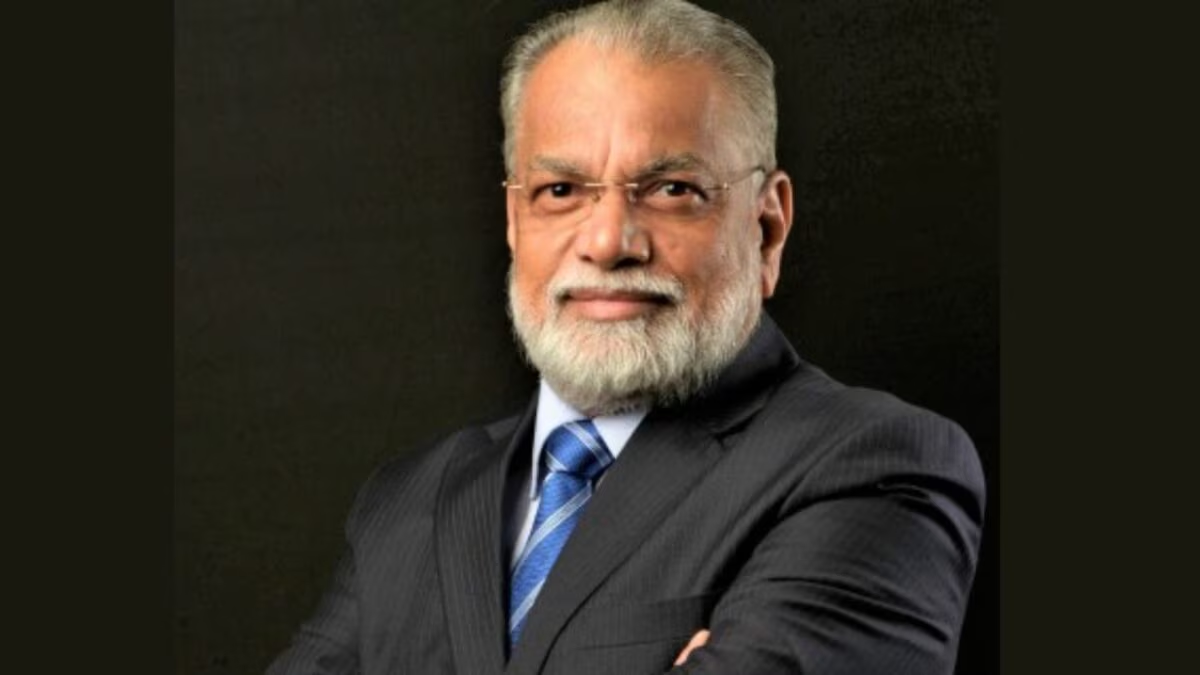
The Radhakrishnan committee proposed conducting NEET in two stages (similar to JEE Main/Advanced), however, this has not been implemented. (Image: LinkedIn/Radhakrishnan Koppillil)
Before the new task force led by Infosys co-founder Nandan Nilekani, the government had taken steps to reform India’s examination system through a high-level committee headed by former ISRO chairman Dr K Radhakrishnan. The panel was formed in June 2024 after concerns over paper leaks and irregularities arose over that year’s NEET-UG and UGC-NET exams.
In 2024, a nationwide crisis was reported involving allegations of NEET paper leak, unfair “grace marks,” and an unprecedented number of perfect scores. This led to massive protests, multiple Supreme Court hearings, and a CBI investigation into the NTA conduct.
Following this, the Radhakrishnan committee was formed, which submitted its report in October 2024 featuring 101 recommendations including examination reforms, data security, technology use and restructuring of the NTA.
One of its key suggestions was to strengthen the NTA by hiring more permanent experts, reducing dependence on contractors and creating specialised teams for test development and exam administration. Currently, NTA has 24 permanent employees and relies on 197 contract outsourced workers. Let’s take a look at the recommendations made by the Radhakrishnan committee.
Involvement of state govts: The panel recommended greater involvement of state governments in conducting entrance exams like NEET. It suggested setting up state-level and district-level coordination committees to help select secure examination centres, coordinate with police and local authorities, supervise the movement and storage of question papers, and respond quickly to security issues. The committee also suggested giving preference to govt institutions as exam centres wherever possible.
Question paper security: Improving question paper security was another major focus area. The committee recommended detailed standard operating procedures for every stage of the examination process, including question paper preparation, printing, transportation, storage, candidate verification, invigilation and handling of answer sheets. It also suggested better systems to identify suspicious patterns in exam centre allocation.
Biometric verification: The committee proposed wider use of technology through a planned “Digi-Exam” system. The recommendations included Aadhaar-based and biometric verification of candidates, multiple levels of identity checks, encrypted transfer of question papers, stronger cybersecurity systems and printing papers closer to examination centres to reduce the risk of leaks.
It also proposed conducting NEET in two stages (similar to JEE Main/Advanced), however, this has not been implemented. The committee also suggested digital question transmission (hybrid model) to prevent leaks. However, NEET 2026 remained a paper-based exam, which investigators believe enabled the Rajasthan leak.
As per media reports, 27 of the 101 recommendations have not been implemented. The government has introduced Aadhaar-based biometric authentication for NEET candidates, expanded CCTV monitoring, increased security checks, used AI-based data analysis and created additional senior-level positions in the NTA. The role of government institutions in conducting exams also increased.
However, some long-term reforms are still being rolled out. These include expanding AI-based monitoring, strengthening information security systems, introducing multi-session examinations and moving towards a more unified, technology-driven entrance examination system across the country.
About the Author

A team of reporters, writers and editors brings you news, analyses and information on college and school admissions, board and competitive exams, career options, topper interviews, job notifications, …Read More
Read More