
Consent Required For CBSE APAAR ID: Supreme Court Directs Opt-Out Option In Forms | Education and Career News
Last Updated:
The petitioners argued that the scheme compelled students to obtain Aadhaar IDs and raised concerns over the collection, storage and processing of children’s personal data.




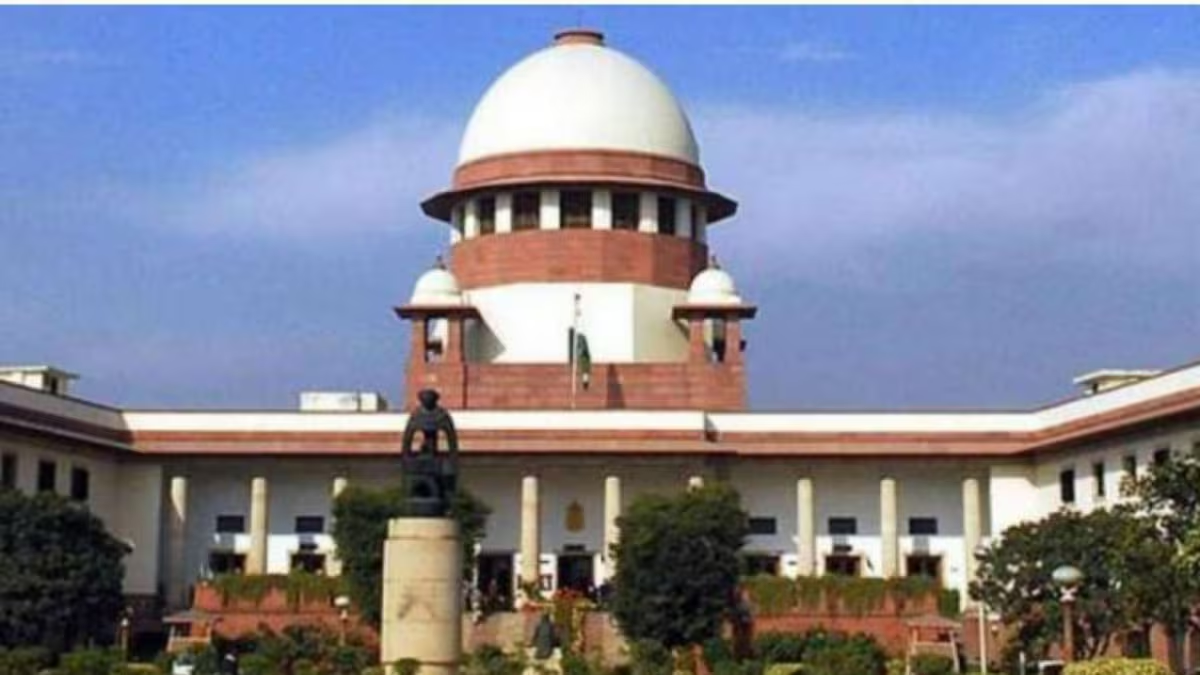
File Photo of Supreme Court of India. (PTI)
The Supreme Court on Monday said it would direct the Central Board of Secondary Education (CBSE) to implement the Orissa High Court’s direction requiring changes to the consent form used for generating APAAR (Automated Permanent Academic Account Registry) IDs. The amended form must provide parents with an explicit option to refuse consent or opt out of the scheme, reported Live Law.
A bench comprising Chief Justice of India Surya Kant, Justice Joymalya Bagchi and Justice V. Mohana was hearing a petition filed by parents of four students challenging the constitutional validity of the APAAR scheme. The petitioners argued that the scheme effectively compelled students to obtain Aadhaar IDs and raised concerns over the collection, storage and processing of children’s personal data.
Senior Advocate Indira Jaising, appearing for the petitioners, stated that the scheme involved serious privacy concerns. Referring to the Supreme Court’s 2019 judgment in K.S. Puttaswamy v. Union of India, she argued that children cannot be forced to obtain Aadhaar numbers.
Jaising contended that although APAAR is described as voluntary by the government, it operates as mandatory in practice because the ID is linked to Aadhaar and required for certain academic processes. She argued that making education and examinations conditional upon Aadhaar-linked identification violates constitutional rights.
The Chief Justice observed that the objective of APAAR was to create a unique academic identity for students and help authorities maintain records, monitor teacher-student ratios and improve curriculum implementation. However, the petitioners argued that any legitimate objective must be achieved through lawful and proportionate means.
The bench noted that CBSE circulars would remain subject to existing laws, including the Digital Personal Data Protection Act, 2023.
Jaising also relied on a December 2025 Orissa High Court judgment, which held that if APAAR is truly voluntary, the consent form must allow parents to refuse participation at the outset. The High Court had directed authorities to amend the form to include an opt-out option.
After being informed that the Orissa High Court order had not been challenged, the Supreme Court said it would direct CBSE to implement the judgment nationwide.
“We will direct CBSE to implement this judgment on a pan-India basis…,” the Chief Justice said. The detailed order will be uploaded later.
The long-term implications of the APAAR ID scheme are linked to its role in India’s digital education system and its potential necessity for board exams. The scheme aims to digitally store students’ academic information for easy access nationwide.
About the Author

A team of reporters, writers and editors brings you news, analyses and information on college and school admissions, board and competitive exams, career options, topper interviews, job notifications, …Read More
Read More