
CBSE Introduces 40:60 Formula For Class 12 Results Of Gulf Students: What This Means? | Education and Career News
Last Updated:
As per CBSE, subjects in which exams could not be conducted, performance would be evaluated based on the marks obtained in Class 10 and the last-attempted Class 12 board exam.


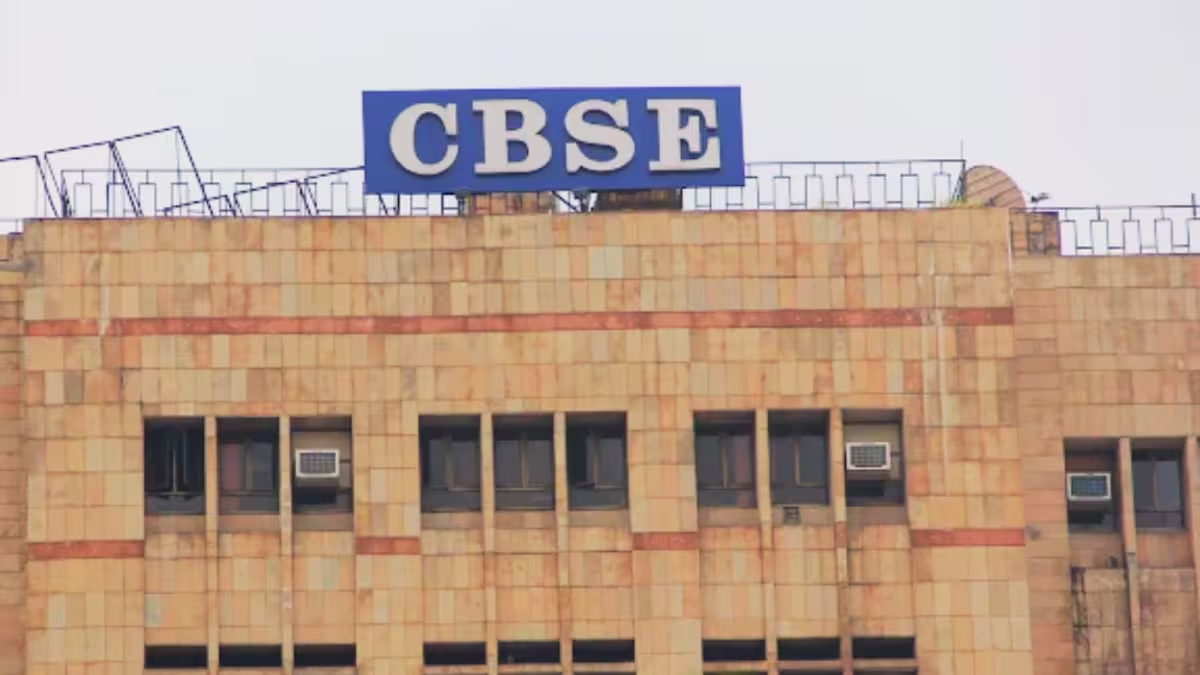
CBSE cancelled the Class 12 board exams in seven West Asian countries due to the conflict in West Asia. (File Photo)
The Centre on Monday informed the Supreme Court that the CBSE has introduced a new policy for evaluating private students affected by the cancellation of Class 12 board exams in Gulf countries amid the recent Iran-US conflict.
A bench comprising Justices S V N Bhatti and Vipul M Pancholi was informed by Solicitor General Tushar Mehta, appearing for the Centre and the CBSE, that a fresh nationwide policy had been formulated to address the concerns of similarly placed students impacted by the cancellation of examinations in Gulf countries due to the regional conflict, reported PTI.
Mehta explained that two categories of students were significantly affected by the cancellation of examinations across seven Gulf countries—regular school students and private candidates. He added that under the new policy, notified on June 21, a separate formula was devised for assessing private students appearing for the board examinations.
Providing details, Mehta said that for subjects in which examinations could not be conducted, performance would be evaluated based on the marks obtained by the private candidate in Class 10 and the last-attempted Class 12 board examination.
What Is The 40:60 Formula?
Under the new policy, for determining the marks in subjects for which examinations could not be conducted, 40 per cent weightage will be given to the theory marks of Class 10 board examination and 60 per cent weightage will be given to the theory marks of Class 12 board examination.
Mehta noted that private candidates presented a unique challenge because they had no school records to provide internal assessment data such as quarterly, half-yearly, and pre-board examination marks, which formed the basis of the original March 27 evaluation scheme.
The Supreme Court was hearing a plea filed by one Pransu Jigarkumar Patel, a private candidate from Al Jubail, Saudi Arabia, who challenged CBSE’s failure to declare his Class 12 improvement examination results under the original evaluation scheme.
The petitioner argued that while CBSE’s March 27 assessment scheme covered regular students, no clarification had been issued for private candidates appearing for improvement examinations, leading to his result being withheld as “Result Later” (R.L.).
He contended that the omission was arbitrary and discriminatory and had adversely impacted his higher education prospects.
Patel submitted that while the Physics and Chemistry examinations were conducted, the Mathematics, English, and Computer Science papers were cancelled.
He further stated that the Physics and Chemistry papers he appeared for were evaluated on the basis of actual marks obtained, whereas the three cancelled subjects were assessed under the new formula notified on June 21.
Mehta informed the bench that under the revised policy, Patel’s assessed marks were higher than his previous performance. He added that the result had been communicated to him via email and would also be updated in his DigiLocker.
He further said that the policy allows students dissatisfied with their assessed marks to appear in the next regular examination.
The bench asked counsel for the petitioner whether his concerns had been addressed following CBSE’s announcement of the new policy.
Advocate Vineet Jindal, appearing for the petitioner, acknowledged that the result had been declared but requested the court to safeguard Patel’s right to obtain copies of answer scripts and seek re-evaluation in accordance with CBSE rules.
The bench referred to the writ petition and observed that no such relief had been sought in the plea, clarifying that the court could not grant relief that had not been requested.
After recording the submissions of the solicitor general, the bench disposed of the matter and granted liberty to the petitioner to pursue appropriate legal remedies should any grievance remain.
The CBSE had cancelled Class 12 board examinations in seven West Asian countries—Bahrain, Iran, Kuwait, Oman, Qatar, Saudi Arabia, and the UAE—due to the conflict in West Asia.
About the Author

A team of reporters, writers and editors brings you news, analyses and information on college and school admissions, board and competitive exams, career options, topper interviews, job notifications, …Read More
Read More