
CBSE 3-Language Policy: Foreign Languages Not Removed; Claims ‘Factually Incorrect’, Board Tells SC | Education and Career News
Last Updated:
CBSE said foreign languages remain part of the Scheme of Studies and can be taken as one of the three languages or as an optional fourth language.




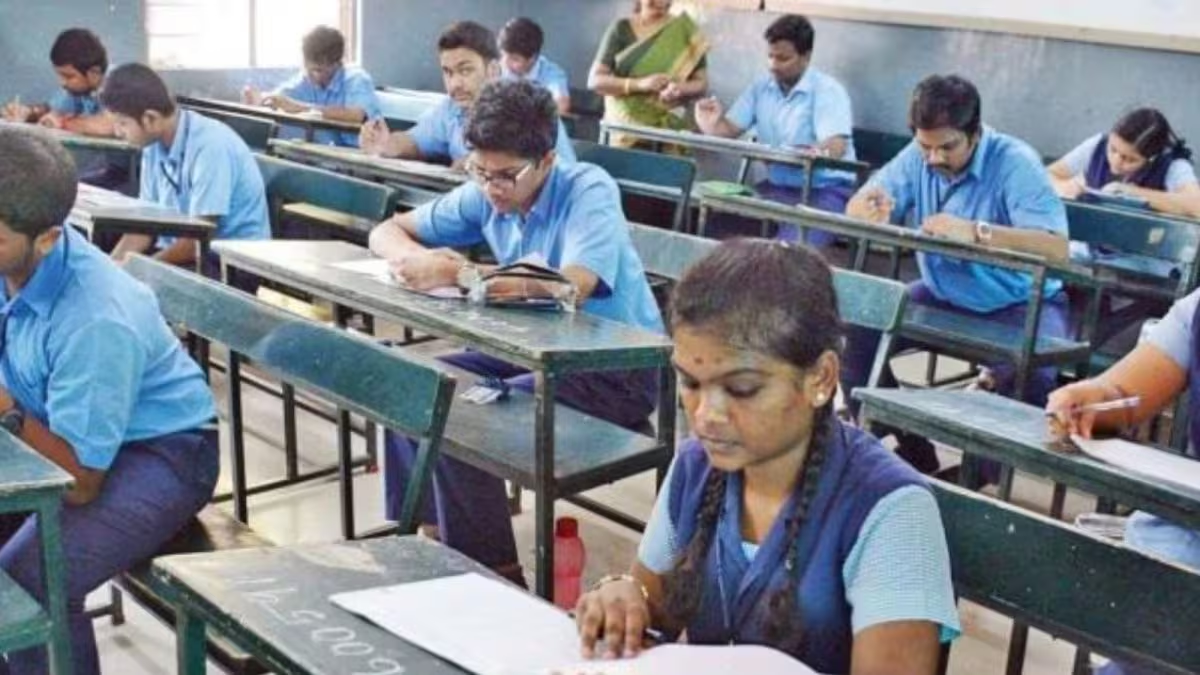
CBSE dismissed concerns over a shortage of teachers, textbooks and learning resources. (Representational/File Photo)
The Centre, the Central Board of Secondary Education (CBSE) and the National Council of Educational Research and Training (NCERT) have defended the implementation of the National Education Policy (NEP) 2020’s three-language framework before the Supreme Court, arguing that it is crucial for fostering multilingualism and strengthening national integration.
In separate affidavits, the Union Ministry of Education, the CBSE and the NCERT have urged the apex court to dismiss petitions challenging the three-language policy introduced in CBSE-affiliated schools across the country.
At the same time, a bench led by Chief Justice of India (CJI) Surya Kant on Tuesday sought responses from the Centre, the CBSE and the NCERT on two fresh petitions questioning the board’s policy requiring Class 9 students to study three languages, including two Indian languages.
In its affidavit, the Ministry of Education stated that the three-language framework is a key element of the NEP’s broader education reforms, aimed at promoting multilingualism and national unity. It said recommendations on language education and multilingual learning form an integral part of the policy’s vision.
Referring to the National Curriculum Framework for School Education (NCFSE) 2023, the ministry said it reinforces the implementation of the three-language formula by recommending that students study three languages from classes 6 to 10, with at least two being Indian languages.
The ministry added that the policy seeks to instil a deep sense of pride in being Indian while equipping learners with the knowledge, skills and values needed to uphold human rights, promote sustainable development and contribute to global well-being.
The CBSE, in its affidavit, said the revised language policy has been rolled out in a planned, phased and systematic manner and does not compel students to give up foreign languages.
Responding to a petition challenging its May 15 circular introducing the new scheme, the board argued that decisions relating to curriculum design, language choices, pedagogy and assessment fall within the domain of expert educational bodies, where judicial intervention is limited. It also submitted that the concerns raised by the petitioners have largely been addressed through guidelines issued on June 29 and a subsequent circular dated July 10, which provide transitional relaxations, exemptions and safeguards to ensure that students are not adversely affected during implementation.
According to the CBSE, students currently in Class 10 during the 2026–27 academic session will continue under the existing two-language system and will not be required to study a third language.
For students presently in Class 12, the board said the third language (R3) will be assessed only through internal school-based evaluation, with no separate board examination in the 2027–28 Class 10 board exams.
The CBSE further said students who had already chosen two non-Indian languages, such as English and French, will be allowed a one-time relaxation to continue studying both while adding one Indian language as the third subject.
Rejecting the petitioners’ claim that foreign-language education has been removed, the board described the allegation as “factually incorrect”. It clarified that foreign languages remain part of the Scheme of Studies and can either be studied as one of the three languages, provided the other two are Indian languages, or as an optional fourth language, reported PTI.
The board also dismissed concerns over a shortage of teachers, textbooks and learning resources. It informed the court that the NCERT has begun developing grade-appropriate learning material, while schools have been permitted to adopt flexible staffing arrangements, including deploying existing teachers with functional proficiency, engaging retired teachers and qualified postgraduates, sharing resources through Sahodaya school clusters and using virtual or hybrid teaching methods.
It also highlighted provisions allowing students whose parents relocate to another state to continue with their existing language combination.
Defending the policy’s constitutional validity, the CBSE argued that its May 15 circular is neither arbitrary nor discriminatory and does not violate Articles 14, 19(1)(g), 21, 21A or 29 of the Constitution.
In a separate affidavit filed by its director, Professor Dinesh Prasad Saklani, the NCERT said the curriculum changes are intended to promote competency-based learning, multilingual education, age-appropriate pedagogy and a stronger connection with India’s linguistic and cultural diversity.
The NCERT said it has completed the academic and administrative processes for reviewing, vetting, finalising and approving R3 language learning material for Class 9 in all 22 Scheduled Languages. It added that Class 9 learning resources for Hindi, Sanskrit, Marathi and Urdu have already been prepared and uploaded to the NCERT website.
Foreign languages will not be completely removed from CBSE schools, as the board has stated that claims of their removal are factually incorrect. Foreign languages remain part of the Scheme of Studies and can be taken as one of the three languages or as an optional fourth language.
About the Author

A team of reporters, writers and editors brings you news, analyses and information on college and school admissions, board and competitive exams, career options, topper interviews, job notifications, …Read More
Read More