
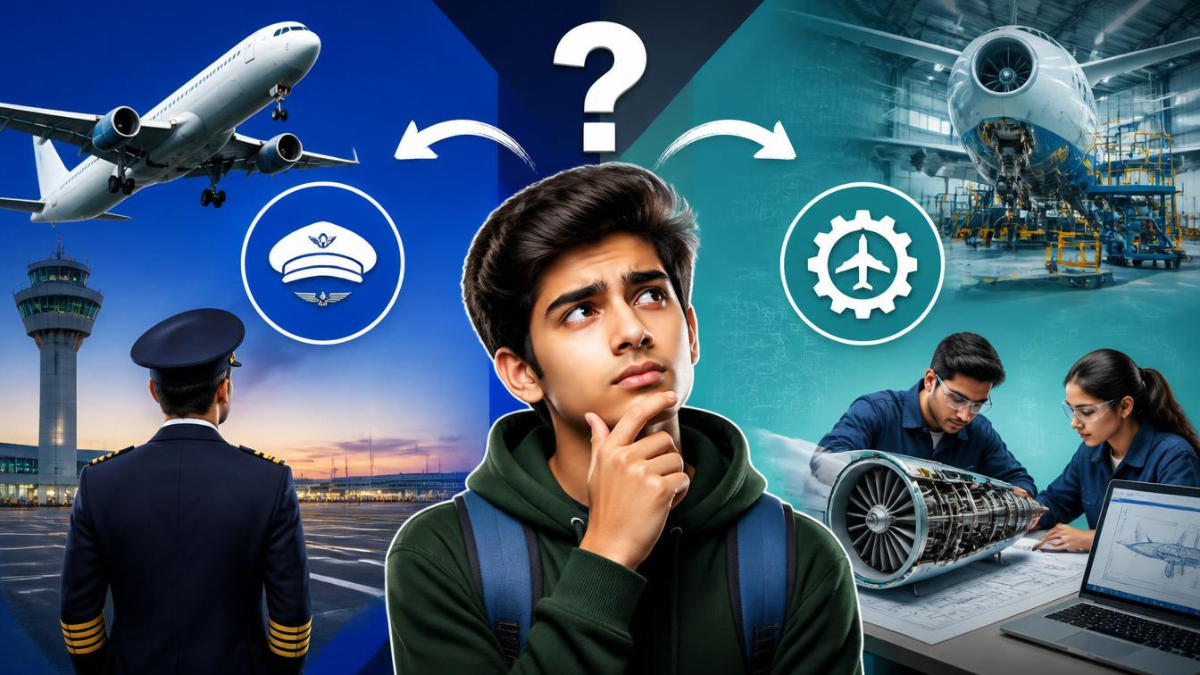
Aviation vs Aeronautics: Which course should you choose after Class 12? | Education News
By Dr Kishore Kumar, Dr Manikandan Murugaiah and Dr Ramraj H. Sundararaj
For many students interested in aircraft, the counselling process presents a deceptively simple choice: Aviation or Aeronautics. The similarity in their names often creates the impression that they are interchangeable pathways to the same career. In reality, they represent two distinct academic disciplines with different areas of study, skill requirements and career opportunities.
Understanding this distinction is essential before selecting a course, as the choice can shape not only the curriculum a student follows but also the career they eventually build.
Aviation and Aeronautics
At its simplest, Aviation is about operating and managing the ecosystem that enables air travel. It encompasses airlines, airports, cargo operations, aviation safety, regulatory bodies, flight operations, customer services and airport management. The focus is on ensuring that aircraft, passengers and cargo move safely and efficiently.
Aeronautics, on the other hand, is an engineering discipline. It deals with the science, design, development, testing and maintenance of aircraft that operate within Earth’s atmosphere. Students study aerodynamics, propulsion, aircraft structures, flight mechanics, materials and control systems to understand how aircraft are built, perform and evolve.
Aviation keeps the industry running; Aeronautics builds the machines that make the industry possible
The biggest difference lies in the kind of problems you want to solve. If you are fascinated by how airlines function, how airports handle millions of passengers every year, how flight schedules are planned or how aviation businesses are managed, Aviation is likely to align better with your interests. If you enjoy Physics, Mathematics, engineering design and understanding how an aircraft flies, Aeronautics offers a far more technical and research-oriented pathway. Students spend considerable time working on aircraft systems, computational simulations, laboratory experiments and design projects.
Story continues below this ad
Another misconception we frequently encounter is that students who want to become pilots should automatically pursue Aeronautical Engineering. In reality, becoming a commercial pilot follows a separate training and licensing pathway. Likewise, students interested in aircraft design may not necessarily aspire to fly aircraft. Recognising this distinction early helps students make informed academic choices instead of selecting courses based solely on familiar terminology.
Both fields offer rewarding careers, but the opportunities are quite different
Graduates in Aeronautical Engineering typically find opportunities with aircraft manufacturers, defence organisations, maintenance, repair and overhaul (MRO) companies, unmanned aerial vehicle (drone) developers, research laboratories and space technology organisations. Roles may include aircraft design, structural analysis, propulsion engineering, flight testing, systems integration and maintenance engineering.
Graduates in Aviation usually pursue careers in airline operations, airport management, aviation safety, air cargo and logistics, ground operations, flight dispatch, aviation consulting, customer experience, regulatory services and airline administration. Many professionals also build careers in rapidly expanding areas such as airport infrastructure development and aviation services.
Aviation and Aeronautics jobs are both expected to increase
Story continues below this ad
India’s aviation ecosystem is entering a period of sustained expansion. India is today the world’s third-largest domestic aviation market, with over 411 million passengers handled in FY25, while the country now has more than 100 operational airports, reflecting the rapid expansion of aviation infrastructure over the past decade (Ministry of Civil Aviation/IndBiz). At the same time, aircraft fleet expansion is expected to continue at an unprecedented pace. Boeing estimates that airlines in India and South Asia will require more than 2,800 new commercial aircraft over the next 20 years, effectively quadrupling today’s fleet to meet rising travel demand (Boeing Commercial Market Outlook, 2025).
These developments, coupled with increased investments in defence, aircraft manufacturing, Maintenance, Repair and Overhaul (MRO), and emerging technologies such as drones and advanced air mobility, are creating opportunities across both engineering and operational functions.
However, students should resist choosing a programme solely based on starting salaries. Career progression in both Aviation and Aeronautics depends far more on technical competence, practical exposure, internships, software proficiency, communication skills and the ability to continuously learn as technologies evolve. Engineering graduates who develop strong analytical capabilities and hands-on project experience are increasingly finding opportunities across aerospace manufacturing, defence, advanced air mobility, unmanned aerial systems, research and product development. Similarly, Aviation graduates who understand airport operations, regulatory frameworks, airline economics and safety management can progress into leadership roles across airlines, airports, logistics, aviation consulting and regulatory organisations.
In our interactions with recruiters and industry partners, one trend has become increasingly clear: employers are looking beyond academic qualifications alone. They value graduates who combine domain knowledge with problem-solving ability, digital skills, multidisciplinary thinking and adaptability, qualities that will remain relevant regardless of how technology transforms the aviation sector.
In conclusion, there is no universal “best” option
Story continues below this ad
The right choice depends on your aptitude and long-term aspirations.
Choose Aeronautics if you enjoy Physics and Mathematics, are curious about how aircraft are designed and tested, and see yourself building technologies that push the boundaries of flight. Choose Aviation if you are interested in the business and operational side of the aviation industry, enjoy working with people and systems, and aspire to contribute to the safe and efficient movement of passengers and cargo.
As educators, we also encourage students to look beyond impressive course titles and focus instead on the problems they want to solve.
The authors are faculty members of the Department of Aerospace Engineering, Ramaiah Institute of Science and Management (RISM), a Distinct Deemed to be University.