
No physical papers, multi-set questions, AI checks: Inside the proposed blueprint to fix NEET UG exam | Education News
The Supreme Court on June 1 refused to issue directions on a petition seeking to conduct the National Eligibility cum Entrance Test (NEET-UG 2026) June 21 retest in computer-based format instead of the current pen-and-paper mode. The apex court expressed its unwillingness to intervene at this stage and postponed consideration of the matter until July, after the court’s partial working days conclude.
In the past few weeks, as NTA announced cancellation and the Ministry of Education repeated commitments to ensure irregularities do not go unchecked, two bodies, the Coaching Federation of India (CFI) and the FAIMA, have placed a series of recommendations before the government and NTA, seeking changes in how NEET is conducted. Here’s a look at what the suggested changes are.
Eliminating physical paper
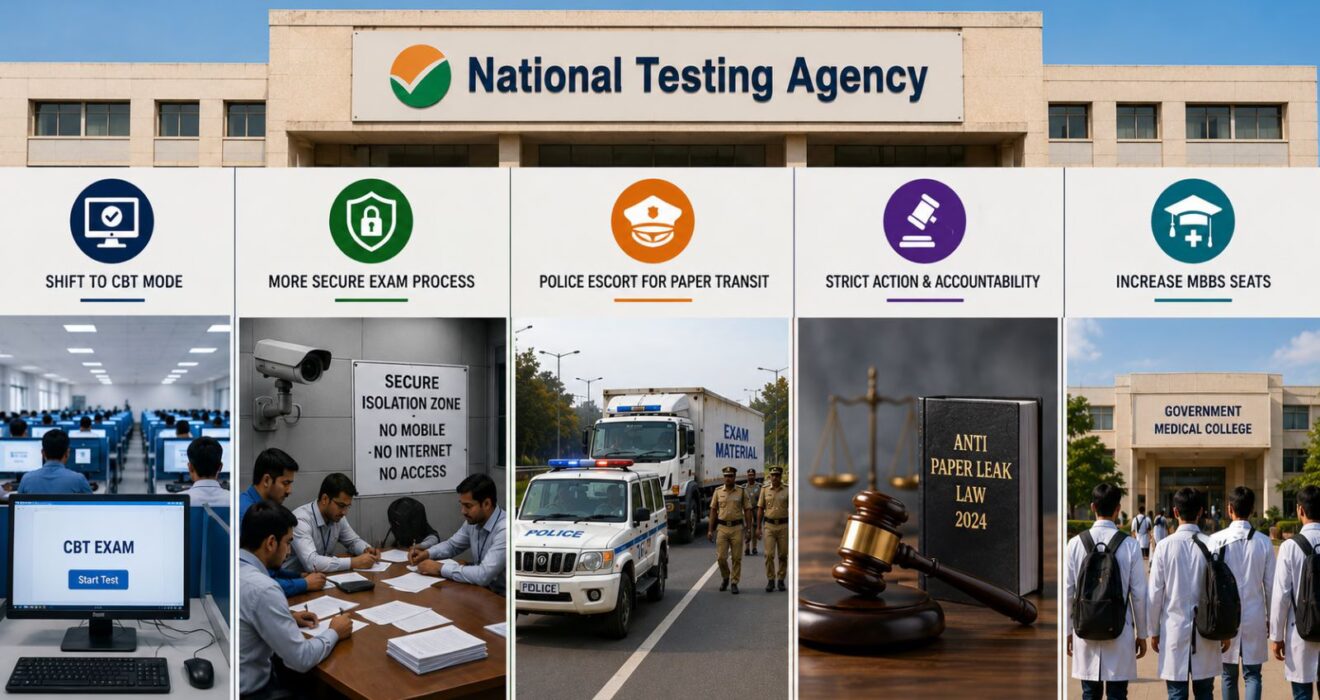
CFI’s central proposal is a “Secure Isolation and Encrypted Printing Model”. Paper setters, translators, and typists would be held in a secure government guest house four to five days before the exam, with phones and internet access confiscated. All subject questions and translations into official languages would be prepared inside this facility.
Read | NEET UG: NTA defends June 21 retest before parliamentary panel
The final paper would be encrypted using AES-256 encryption and transmitted digitally to exam centres. No printed paper would exist beforehand. Printing would happen inside CCTV-monitored strong rooms at individual centres roughly two hours before the exam, with students already seated and cut off from outside communication.
CFI estimates installing two high-speed printers at 5,400 centres would cost around Rs 162 crore — against the Rs 500–800 crore cost of cancelling and reconducting a national exam.
Also read | NEET was supposed to be leak-proof in 2026. Here’s how the system built to protect the exam failed
Story continues below this ad
Both CFI and FAIMA have also called for a shift to computer-based or hybrid examinations, arguing that CBT allows question papers to be transmitted minutes before the exam. The proposal is contested, however — conducting CBT for over 22 lakh students would require multiple shifts and significant digital infrastructure.
CFI has also called for permanent blacklisting of centres linked to past malpractice and pre-exam surveillance by intelligence agencies and state police in locations that have repeatedly featured in leak investigations, including Sikar, Patna, Nashik, Latur, Belgavi, and Hazaribagh.
Restructuring the examination
CFI wants a two-tier system modelled on JEE Main and JEE Advanced. All students would appear for a preliminary exam; only the top 20–30 per cent would qualify for a separate Mains under tighter security. The federation argues this limits the damage from any single leak.
It has also proposed preparing around 20 separate question paper sets, with different portions of the final paper drawn from different master sets, so no single setter knows the complete final paper.
Story continues below this ad
On paper quality, CFI wants offline AI tools to verify that every question falls within the NEET syllabus and to generate solutions before the paper is finalised. Answer keys should be released with detailed solutions, challenges to answer keys should be free for students, and paper setters should be held accountable for incorrect questions.
Enforcement and legal action
CFI has pushed for full implementation of the Public Examinations (Prevention of Unfair Means) Act, 2024, which provides for up to 10 years’ imprisonment and fines of up to Rs 1 crore in serious cases. It wants criminal prosecution, asset seizure, and blacklisting of institutions and vendors found linked to malpractice, including coaching institutes.
Institutional overhaul and oversight
FAIMA’s demands focus on accountability. It has called for either replacing the NTA or restructuring it into a more autonomous body, arguing that repeated controversies have damaged confidence in the existing system.
It has also sought a monitoring committee — comprising a retired Supreme Court judge, a cybersecurity expert and a forensic scientist — to supervise any re-conduct of NEET-UG 2026, pending the formal creation of a National Examination Integrity Commission (NEIC).
Story continues below this ad
FAIMA wants the re-exam held under judicial supervision, with the Supreme Court or a court-appointed body certifying the security of the revised process before the exam is conducted. It has also sought a status report from the CBI on the ongoing paper leak investigation, including arrests, charges, and prosecution progress.
Long-term structural changes
CFI has argued that the pressure created by competition for a limited number of seats itself drives malpractice. Currently, around 22 lakh aspirants compete for roughly 60,000 government MBBS seats. The federation has called for expanding government MBBS seats to 2–3 lakh over the next decade and for capping NEET attempts at four consecutive attempts, along the lines of JEE.
Where CFI and FAIMA’s demands resonate with Radhakrishnan committee recommendations
The K Radhakrishnan Committee, constituted by the Ministry of Education after the NEET-UG 2024 controversy, had recommended restructuring the NTA into a more accountable body, shifting toward technology-driven examination systems, reducing dependence on physical paper transport, exploring hybrid models with encrypted digital transmission and on-site printing, and moving to multi-stage examinations.
Broadly, most of what CFI and FAIMA are now asking for sits within that same framework — the difference is in specificity and urgency.
Story continues below this ad
Where the committee made directional recommendations, CFI has returned with implementation details: a named encryption standard, a cost estimate for printer installation, and a defined isolation period for paper setters.
FAIMA has gone further on the institutional side, not just asking for a restructured NTA but for interim judicial oversight and a formal statutory body in the NEIC — neither of which the committee explicitly proposed.
The area where both organisations depart most clearly from the committee’s scope is enforcement: the demand for full invocation of the 2024 anti-paper-leak law, asset seizure, blacklisting of vendors and coaching institutes, and a CBI status report are accountability demands that go beyond what an examination reform committee would typically address.
What the two years since the Radhakrishnan report reveal is that the recommendations were largely accepted in principle and largely unimplemented in practice, which is why the same proposals are reappearing, this time with more specificity and from more stakeholders.