
Supreme Court Urges Centre To Review CBSE’s 3-Language Policy From Class 9: ‘It’s Stressful’ | India News
Last Updated:
Supreme Court questions CBSE’s third language policy for Class 9, citing student stress. Justice Nagarathna suggests earlier introduction, urges Centre to reconsider.




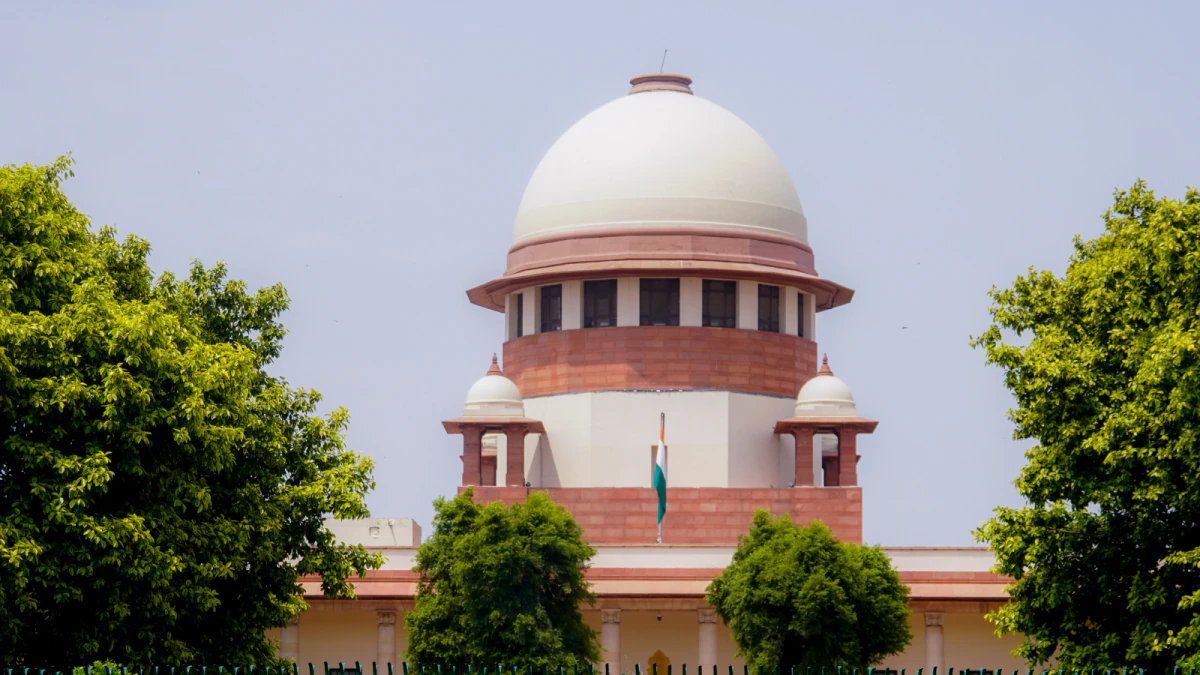
Supreme Court of India (Photo: PTI)
The Supreme Court on Thursday expressed reservations over introducing a third language at the Class 9 level under the Central Board of Secondary Education (CBSE) curriculum and observed that it “places unnecessary stress on students preparing for board examinations.”
The remarks came during the hearing of the Tamil Nadu government’s appeal against a Madras High Court order directing the state to facilitate the establishment of Jawahar Navodaya Vidyalayas in every district.
During the proceedings, the state’s counsel submitted that Tamil Nadu’s objections were linked to the Centre’s three-language policy.
Responding to the submissions, Justice B V Nagarathna questioned the timing of introducing a third language, saying students should begin learning it much earlier.
Introduce New Language In Class 6: SC
“No, that is very bad. Ninth standard is stressful. Why do you introduce a new language in 9th? You introduce it in 6th,” he said.
Addressing the Centre, the judge urged education authorities to reconsider the policy.
Also Read: ‘Can English Be Considered An Indigenous Indian Language?’: SC Questions NEP’s Three-Language Policy
“Union of India, please don’t have third language in 9th standard. CBSE, ICSE, State Board, 10th standard is a board exam. From the end of 8th standard onwards, the pressure starts,” the Court observed.
Recalling her own schooling, Justice Nagarathna said students in her school were introduced to multiple languages during middle school so they were better prepared before appearing for their secondary school examinations.
“In the middle school the third language was started because that was required for SSLC. It was Kannada for those who had second language as Hindi and vice versa. Sanskrit was also there, so you could have third language. The earlier, the better,” she said.
Drawing on her academic experience from the 1970s, the judge noted that students had begun preparing for board examinations well before Class 10.
“So if we had that kind of preparation and all, what about today’s students? Don’t start a new language in 9th. Start it in 6th… I’m recalling my experience from 1976,” the judge stated.
‘Doesn’t Mandate Hindi As Third Language’
During the hearing, Justice Nagarathna also clarified that the National Education Policy’s three-language framework does not mandate Hindi as the third language.
“The State language has to be taught, English has to be taught and any third language. It doesn’t say Hindi,” she said.
Counsel appearing for the respondent NGO also pointed out that the National Education Policy specifically provides that no language should be imposed on any state.
Justice Nagarathna then asked the Tamil Nadu government, “You don’t want Hindi, but if it’s Sanskrit, what is the issue?”
The state’s counsel replied that the concern was not about a specific language but the requirement of introducing a compulsory third language only from Class 9.
The observations come just two days after a bench led by the Chief Justice of India admitted multiple petitions challenging the three-language policy and issued notices to the Centre, the CBSE and the Ministry of Education.
All About NEP’s Three-Language Policy
The CBSE announced that the third language will be a compulsory qualifying subject for students in Classes 9 and 10 under the National Education Policy (NEP) 2020 framework.
The Board clarified that while the third language will not be included in the Class 10 board examination, students will have to pass a school-based internal assessment in the subject from the 2027-28 academic session.
Students who fail to clear the internal assessment in the third language will not be awarded the Secondary School Examination pass certificate, the CBSE said.
Under the three-language formula, students will be required to study two Bharatiya Bhashas (Indian languages) and one non-native language.
The revised policy will apply to students entering Class 9 in the 2026-27 academic session and Class 10 in 2027-28. However, students who are already in Class 10 during the 2026-27 academic session will not be required to study or qualify in a third language under the new norms.
The Supreme Court has questioned the CBSE’s three-language policy for Class 9 students, calling its introduction “stressful”. The court has refused to grant interim relief on petitions challenging the policy.
About the Author

Ananya Bhatnagar, Principal Correspondent at CNN-News18, reports on various legal issues and cases in lower courts and the Delhi High Court. He has covered the hanging of the Nirbhaya gang-rape convic…Read More
Delhi, India, India
Read More