
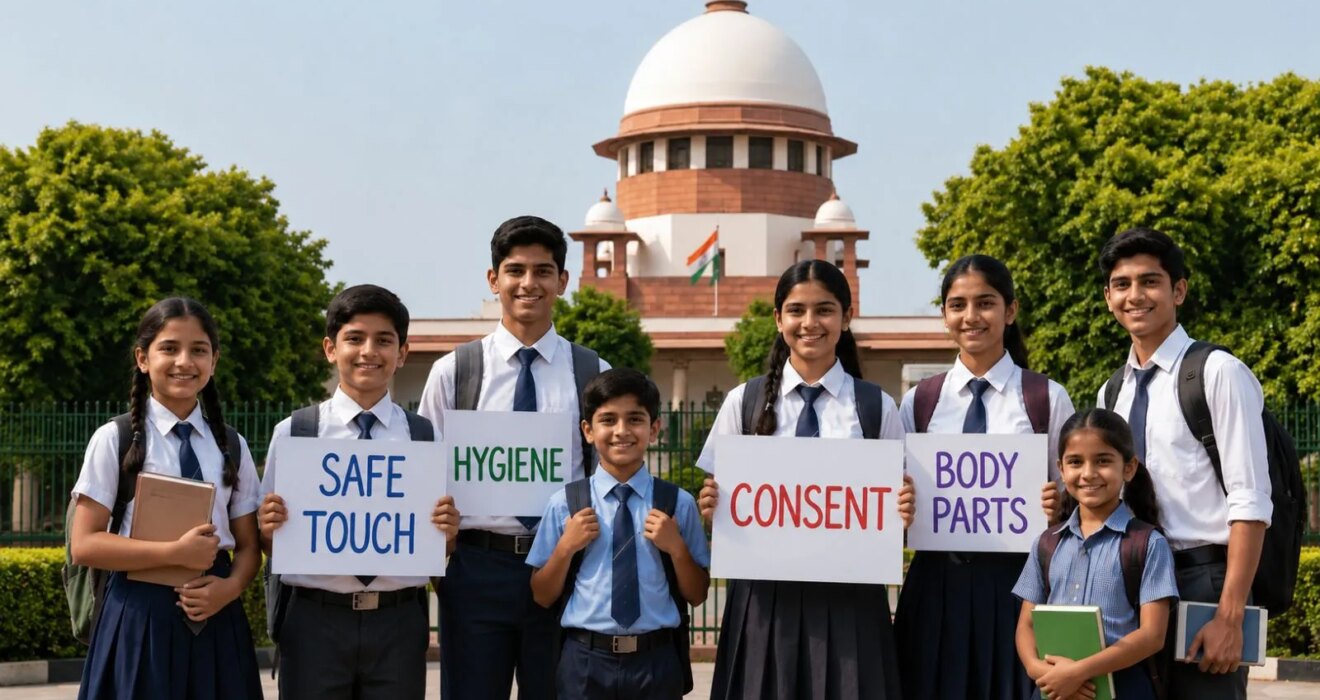
Inside the expert panel’s report: How adolescent education may look in Indian classrooms
Schools and colleges in the country will soon roll out ‘comprehensive sex education’ as the Central Government on Monday informed the Supreme Court that it has agreed to accept the proposals of the national expert committee on adolescent education. The Centre will implement the programme once the apex court gives its nod.
The expert committee, in its report, has proposed introducing adolescent education from Class 6 through a graded approach, with age-appropriate lessons on personal safety, body awareness, hygiene, and safe and unsafe touch beginning from the foundational stage.
The report was submitted to the Centre following the Supreme Court’s directive to address the growing criminalisation of consensual adolescent relationships and minor pregnancies under the Protection of Children from Sexual Offences (POCSO) Act, 2012. The 26-member committee examined the right to privacy of adolescents engaged in consensual sexual relationships in the context of the POCSO Act and the broader child protection framework.
The submission was made before a bench of Justices B V Nagarathna and R Mahadevan.
The recommendations form part of a broader framework for introducing Adolescent Education in schools and colleges in alignment with the National Education Policy (NEP) 2020. The current programmes, which integrate safety and security concerns with age-appropriate awareness, may be reviewed and supplemented, as deemed fit, to fulfil the NEP’s core principles of holistic development, critical thinking, and building life skills, or Jeevan Kaushal for the 21st century
From safe touch to consent: What is the Centre’s adolescent education plan?
Curriculum, workshops, & discussions
The Adolescent Education curriculum to be developed by the National Council of Educational Research and Training (NCERT) will include concepts such as gender equality, health and hygiene, cyber safety, emotional well-being, age-appropriate components of sex education, and awareness on Pocso Act.
Story continues below this ad
On the specific issue of consent, the committee has recommended that the concept may be excluded for younger groups and introduced sensitively at the secondary stage in a medico-legal framework. A ‘progressive, age-specific framework’ is to be applied for all topics, across grade bands of 6-8, 9-10, and 11-12, with the curriculum expected to explicitly define how each theme — such as consent or cyber safety — is introduced, built upon, and deepened across these bands.
Among other suggestions, the committee has recommended organising regular dialogues and workshops with parents on the importance of Adolescent Education, incorporating discussions on the Pocso Act and the Prohibition of Child Marriage into parent-teacher meetings, and creating community ambassadors to advocate for it.
Additionally, the committee has recommended that the Ministry of Education be directed to design and publish parent guidebooks outlining age-appropriate approaches for responding to children’s queries in an informed and sensitive manner.
In 2024, the Ministry of Education informed the Rajya Sabha that about seven lakh health and wellness ambassadors have been trained and oriented in 446 districts of 28 states and eight Union Territories.
Story continues below this ad
The committee has recommended that the Ministry of Social Justice and Empowerment, the Ministry of Tribal Affairs, and the Department of Empowerment of Persons with Disabilities be directed to ensure that their various welfare schemes and programmes are tailored to reach marginalised groups, including tribal communities, children with disabilities, and LGBTQ+ youth. It has been recommended that all their training modules incorporate trauma-informed approaches, gender sensitivity, and digital safety, to equip frontline workers with the necessary competencies to address the complex challenges faced by young people today.
Teacher training
Before taking up the Adolescent Education with students, teachers must have undergone training for ‘age-appropriate delivery’ of such modules, curricula, and courses. The primary delivery of the curriculum, it noted, should be by trained teachers, with NGOs having proven experience in child protection involved in capacity-building of teachers.
On capacity building, the committee has recommended a Training of Trainers (ToT) programme for Child Care Institution (CCI) counsellors. The committee stated that capacity building of counsellors and frontline workers is essential to ensure consistent and high-quality support for adolescents, and that this can be achieved by introducing a national certification programme for adolescent counsellors.
It has further recommended that frontline workers, teachers, hostel wardens, caregivers, and support persons be trained at the district level by District Child Protection Units (DCPUs), which may also organise sessions for school and college students through calendar-based programmes.
Other recommendations
Story continues below this ad
The committee has noted that the National Legal Services Authority (NALSA) and the State Legal Services Authorities (SLSAs) will ‘bear significant responsibilities under the prevailing legal framework’, including the disbursal of interim relief, provision of quality legal services for children, and facilitation of compensation to victims under the Pocso Act. Their active involvement, it states, is “pivotal to the overall effectiveness and integrity of Pocso-related schemes,” particularly with respect to accurate and timely data entry in the Pocso Tracking Portal.
It has also been recommended that a provision be made so that information about Pocso cases is visible to all child protection stakeholders for easier access to information.
The committee suggested that mass, widespread awareness campaigns be carried out at the societal and community levels, stating these are essential to foster greater public understanding and sensitisation on issues related to child protection and the legal implications under the Pocso Act. To ensure a more holistic and effective approach, it has recommended introducing an ‘Intergenerational Awareness Programme’, which should not only focus on children and adolescents but also actively involve parents and guardians, who, it notes, often play a critical role in shaping responses and attitudes.
The committee has further recommended that the Ministry of Panchayati Raj and the Ministry of Housing and Urban Affairs be directed to carry out awareness campaigns on child sexual abuse and the provisions of the Pocso Act at the grassroots level, through the use of Information, Education, and Communication (IEC) materials such as animation videos, booklets, street plays, and other audio-visual content.
Story continues below this ad
It has been recommended that these campaigns be youth-friendly, with content that is lucid, clear, concise, and age-appropriate, available in all regional languages, and placed prominently in public spaces such as schools, hospitals, and bus stands, to ensure maximum visibility.