
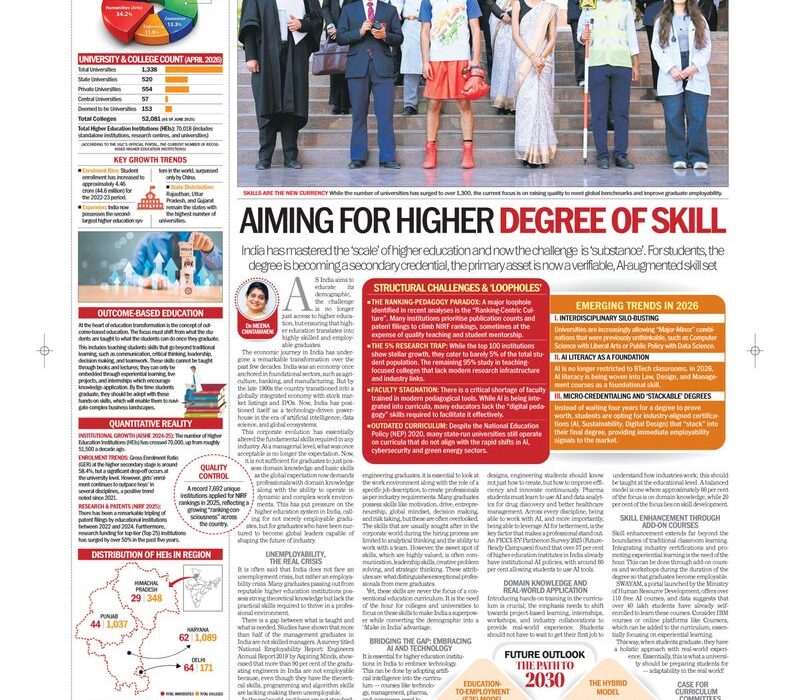
Aiming for higher DEGREE of skill
India has mastered the ‘scale’ of higher education and now the challenge is ‘substance’. For students, the degree is becoming a secondary credential, the primary asset is now a verifiable, AI-augmented skill set
As India aims to educate its demographic, the challenge is no longer just access to higher education, but ensuring that higher education translates into highly skilled and employable graduates.
The economic journey in India has undergone a remarkable transformation over the past few decades. India was an economy once anchored in foundational sectors, such as agriculture, banking, and manufacturing. But by the late 1900s the country transitioned into a globally integrated economy with stock market listings and IPOs. Now, India has positioned itself as a technology-driven powerhouse in the era of artificial intelligence, data science, and global ecosystems.
This corporate evolution has essentially altered the fundamental skills required in any industry. At a managerial level, what was once acceptable is no longer the expectation. Now, it is not sufficient for graduates to just possess domain knowledge and basic skills as the global expectation now demands professionals with domain knowledge along with the ability to operate in dynamic and complex work environments. This has put pressure on the higher education system in India, calling for not merely employable graduates, but for graduates who have been nurtured to become global leaders capable of shaping the future of industry.
Unemployability, The real crisis
It is often said that India does not face an unemployment crisis, but rather an employability crisis. Many graduates passing out from reputable higher education institutions possess strong theoretical knowledge but lack the practical skills required to thrive in a professional environment.
There is a gap between what is taught and what is needed. Studies have shown that more than half of the management graduates in India are not skilled managers. A survey titled ‘National Employability Report: Engineers Annual Report 2019’ by Aspiring Minds, showcased that more than 90 per cent of the graduating engineers in India are not employable because, even though they have the theoretical skills, programming and algorithm skills are lacking making them unemployable.
In the real world, problems are not standardised; traditional education focuses on knowledge acquisition, but modern workplaces require adaptability, communication, problem-solving, and real-world application.
Whether we consider BBA, management or engineering graduates, it is essential to look at the work environment along with the role of a specific job description, to create professionals as per industry requirements. Many graduates possess skills like motivation, drive, entrepreneurship, global mindset, decision making, and risk taking, but these are often overlooked. The skills that are usually sought after in the corporate world during the hiring process are limited to analytical thinking and the ability to work with a team. However, the sweet spot of skills, which are highly valued, is often communication, leadership skills, creative problem solving, and strategic thinking. These attributes are what distinguishes exceptional professionals from mere graduates.
Yet, these skills are never the focus of a conventional education curriculum. It is the need of the hour for colleges and universities to focus on these skills to make India a superpower while converting the demographic into a ‘Make in India’ advantage.
Bridging the gap: Embracing AI and technology
It is essential for higher education institutions in India to embrace technology. This can be done by adopting artificial intelligence into the curriculum — courses like technology, management, pharma, and commerce need to focus on artificial intelligence as they are no longer just niche areas, but the norm.
A commerce student must go beyond reading balance sheets; with data analytics tools, a commerce student should be able to predict company performance, assess risk, and make informed investment decisions. A management student should be able to forecast market trends and interpret large data sets using predictive AI. Using virtual simulations, predictive modelling, and AI-driven designs, engineering students should know not just how to create, but how to improve efficiency and innovate continuously. Pharma students must learn to use AI and data analytics for drug discovery and better healthcare management. Across every discipline, being able to work with AI, and more importantly, being able to leverage AI for betterment, is the key factor that makes a professional stand out. An FICCI-EY-Parthenon Survey 2025 (Future-Ready Campuses) found that over 57 per cent of higher education institutes in India already have institutional AI policies, with around 60 per cent allowing students to use AI tools.
Domain knowledge and real-world application
Introducing hands-on training in the curriculum is crucial; the emphasis needs to shift towards project-based learning, internships, workshops, and industry collaborations to provide real-world experience. Students should not have to wait to get their first job to understand how industries work; this should be taught at the educational level. A balanced model is one where approximately 80 per cent of the focus is on domain knowledge, while 20 per cent of the focus lies on skill development.
Skill enhancement through add-on courses
Skill enhancement extends far beyond the boundaries of traditional classroom learning. Integrating industry certifications and promoting experiential learning is the need of the hour. This can be done through add-on courses and workshops during the duration of the degree so that graduates become employable.
SWAYAM, a portal launched by the Ministry of Human Resource Development, offers over 110 free AI courses, and data suggests that over 40 lakh students have already self-enrolled to learn these courses. Consider IBM courses or online platforms like Coursera, which can be added to the curriculum, essentially focusing on experiential learning.
This way, when students graduate, they have a holistic approach with real-world experience. Essentially, this is what a university should be preparing students for — adaptability in the real world!
Case for curriculum committees
One of the most effective ways to keep curriculum up-to-date and relevant is through structured feedback. This involves forming curriculum advisory committees with students as the primary stakeholders who can provide insights into the effectiveness and relevance of the courses. Faculty members, also primary stakeholders, can share their feedback on teaching methodologies and academic trends. Asking the students questions about the employability advantage of a course, the relevancy of a course in today’s dynamic business landscape, and the classroom implementation in terms of assimilation and absorption can provide valuable feedback.
From degrees to employability: The way forward
The goal of higher education institutions needs to shift from awarding degrees to creating skilled graduates. The students must be equipped with domain knowledge and practical skills to be prepared for their first job, even before they graduate.
By doing so, universities will play a pivotal role in shaping the future of India by transforming mere graduates into global leaders who will drive economic change, innovation, and growth.
The pressure is on Indian universities and higher education institutes to create not mere graduates, not mere CEOs, but forward-thinking global CEOs.
The Verdict: India has mastered the “Scale” of higher education. The challenge for 2026 and beyond is “Substance”. For students, the degree is becoming a secondary credential; the primary asset is now a verifiable, AI-augmented skill set.
Understanding job environment
One of the most crucial roles of higher educational institutions is to make students job-ready. Essentially, universities must have a deep understanding of the roles students will likely undertake and the challenges they could face, and then prepare their students accordingly. For instance, there has been a rapid rise in the number of global capability centres (GCCs) in cities like Bangalore and Hyderabad.
A press release by the Ministry of Labour and Employment highlighted that India has over 1700 GCCs, which employ around 1.9 million Indian professionals as of 2025, and this number is expected to rise to 2.8 million by 2030. These GCCs require a blend of skills — technical experience, business acumen, and communication ability.
Universities and higher education institutes must be able to understand, and anticipate these requirements and adapt their curriculum accordingly. This forward-thinking approach will ensure that graduates will be prepared to handle the roles offered to them with ease.
Structural Challenges & ‘Loopholes’
n The ranking-pedagogy paradox: A major loophole identified in recent analyses is the “Ranking-Centric Culture”. Many institutions prioritise publication counts and patent filings to climb NIRF rankings, sometimes at the expense of quality teaching and student mentorship.
n The 5% research trap: While the top 100 institutions show stellar growth, they cater to barely 5% of the total student population. The remaining 95% study in teaching-focused colleges that lack modern research infrastructure and industry links.
n Faculty stagnation: There is a critical shortage of faculty trained in modern pedagogical tools. While AI is being integrated into curricula, many educators lack the “digital pedagogy” skills required to facilitate it effectively.
n Outdated curriculum: Despite the National Education Policy (NEP) 2020, many state-run universities still operate on curricula that do not align with the rapid shifts in AI, cybersecurity and green energy sectors.
Emerging Trends in 2026
I. Interdisciplinary silo-busting
Universities are increasingly allowing “Major-Minor” combinations that were previously unthinkable, such as Computer Science with Liberal Arts or Public Policy with Data Science.
II. AI literacy as a foundation
AI is no longer restricted to BTech classrooms. In 2026, AI literacy is being woven into Law, Design, and Management courses as a foundational skill.
III. Micro-credentialing and ‘stackable’ degrees
Instead of waiting four years for a degree to prove worth, students are opting for industry-aligned certifications (AI, Sustainability, Digital Design) that “stack” into their final degree, providing immediate employability signals to the market.