
A shoe, Rs 8,000, no CCTV: How Maharashtra’s TET paper was leaked | Education News
The question papers were meant to be “highly secure”. Over six lakh teachers were to appear for the Maharashtra Teacher Eligibility Test (TET) 2026 on June 28 at 1,028 centres across the state. The papers had been printed at a press in Agra whose identity was kept confidential, with only the head of the examination council dealing with the press, in keeping with the long-standing practice of printing papers outside the state for secrecy.
All it took to defeat this was a shoe.
Between June 15 and 17, an employee at the press slipped folded copies of question papers under the insole of his shoe and walked past security guards, former Army men who frisked his clothes but never checked his footwear. The TET has two papers, Paper 1 and Paper 2, and two sets of each had been printed, so that one set could be picked at random and handed over on exam day. Over three days, all four sets were smuggled out this way, defeating that safeguard too. For this, he and two associates were paid Rs 8,000 each and promised a plot of land apiece.
“Usually even in simple crimes there is a big monetary exchange and a certain amount is paid in advance. We were shocked to find out that the question papers which would impact six lakh teachers across the state were handed over for as little as Rs 8000,” an officer who was part of the multi-state probe told The Indian Express.
What surprised the Thane City police team even more was the design of the enterprise. Unlike other paper leaks, where paper setters or senior management were found involved, this operation needed no one important. Its alleged mastermind, Bijendra Gupta, a former coaching class teacher now absconding, had turned the exam system’s own safety protocol on its head.
An inverted model
Question papers for Maharashtra’s examinations have traditionally been printed outside the state. The logic was that employees at presses in other states would neither be interested nor able to read the contents, helping maintain secrecy. According to senior officials in the state’s School Education Department, the press’s identity is kept strictly confidential once finalised, its name omitted from all official communication within the department.
“Only the head of the institution, in this case the Council, deals with matters related to the printing press. No one else on the Council or even the department has this information,” an official said.
Gupta’s model, as police describe it, made the secrecy irrelevant. Instead of targeting a particular exam, he identified presses across states known to get contracts for printing out-of-state question papers and cultivated employees there. Whatever arrived for printing, he leaked.
“We suspect he did not know which papers would come for printing there. However, when men he had cultivated in these presses handed him a particular question paper, Bijendra, a former coaching classes teacher from Bhopal, tapped into the coaching classes network of that state to get to clients,” a senior IPS officer from Thane City police told The Indian Express.
“He had inverted the system whereby he did not go looking for a particular question paper to leak, but developed people in the printing press and leaked whatever came there for printing,” the officer added.
The vulnerability then extends well beyond one exam. Presses like these print papers for exams big and small conducted by the state through the year, including recruitment tests for executive and non-executive staff at metro corporations, all of it exposed to a model that leaks whatever arrives for printing.
The Agra press, Mahim Patran Pvt Ltd, has printed question papers for examinations conducted by the Maharashtra State Council of Examination (MSCE) for over two decades, according to education department officials who spoke to this newspaper on the condition of anonymity. The Council conducts various state government recruitment exams as well as scholarship exams for Classes 4 and 7. That history is now a line of inquiry. Once Gupta is arrested, the officer said, police will question him on whether he knew the Maharashtra TET paper would be printed there, given the press had handled it for years.
The Bhiwandi unravelling
The leak came to light two days before the exam. Thane City DCP (Zone II) Pavan Bansod received a tip-off from a person in Bhiwandi who claimed he had been approached by three people with a copy of the TET paper. After a go-ahead from Thane City Police Commissioner Ashutosh Dumbare, a raid was carried out.
“When we received a tip off, we initially suspected these would be fraudsters. However, when we sent dummy cops and conducted a raid a day before the exam, the education department confirmed that these were actually papers that were to be distributed during the exams,” Bansod told The Indian Express.
The first three of 12 arrests followed. Rajiv Kumar and Aakash Kumar were arrested from Bihar, Dheeraj Singh from Haryana. Additional Commissioner Ashok Dudhe announced the arrests at a press conference, saying a 20-member SIT had been formed, the case gaining urgency as it came close on the heels of the NEET-UG paper leaks. The NEET-UG paper leak controversy came to light on May 12, 2026, when the National Testing Agency (NTA) cancelled the medical entrance examination for over 20 lakh aspirants and announced a retest, the second time in three years the exam had been hit by a leak. The TET, by contrast, had never been leaked before.
“At that point there was no clarity on the source of the paper link and we kept tracking backward linkages,” Bansod said. Some accused fled after the initial arrests. Nearly a week later, the trail led to Agra.
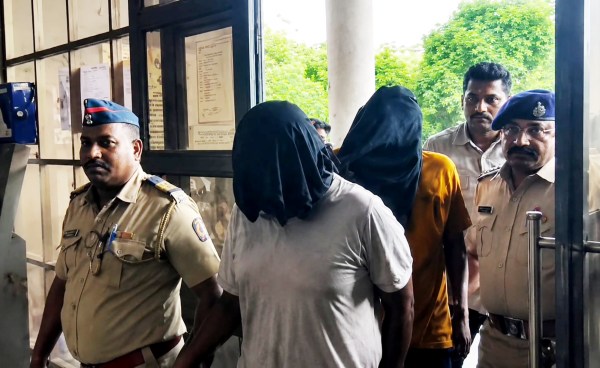 Three men connected to the press were arrested — current employees Nareshkumar Mahore alias Nikki and Babulal Kushwahay, and Sanjay Kumar Sharma, a former employee removed from service two years ago for frequent fights with colleagues.
Three men connected to the press were arrested — current employees Nareshkumar Mahore alias Nikki and Babulal Kushwahay, and Sanjay Kumar Sharma, a former employee removed from service two years ago for frequent fights with colleagues.
“It appears that Bijendra had managed to cultivate the accused,” Bansod said. He said Gupta had reached the employees through a common contact, Sonukumar Kishanlal, an absconding accused, and was aware that the press published question papers of various states.
The cultivation was unhurried. Police found the employees had been in touch with Gupta for a while, and he would fund their drinking sessions through UPI payments. When the Maharashtra TET paper arrived at the press, police suspect, they told him.
ACP (Bhiwandi division) Vijay Marathe described the operation. “Between June 15 and 17, when the papers were printed for the exams to be held on June 28, Kushwahay, who was responsible for packing the paper into bundles which would then be transported to Maharashtra in trucks, would hand over one copy to Mahore,” he said.
“Mahore would remove the insole pad of his shoe where a folded copy of the paper would be placed. At the exit, there would be checks by former army guys who would frisk his clothes and later allow him to go. His shoes were not checked,” the officer said.
The papers went from Mahore to Sharma, and eventually to Gupta through the absconding Sonukumar.
There was one more hole in the press’s defences. A senior Thane police officer said the CCTV at the press was not working, a lapse the police found shocking. “If the cameras were working, maybe Kushwahay or Mahore could have been captured hiding the papers in his shoes,” the officer said. In its statement to police, the press said it had strong security, including former Army personnel, and that there was no laxity on its part. The Indian Express sent an email to Mahim Patran Pvt Ltd detailing the police observations but received no response.
Once the papers reached Gupta, the selling began. A former coaching class teacher from Bhopal, he tapped Maharashtra’s coaching network for buyers. “Their target was to sell atleast 5000 papers. Bijendra sold a paper for Rs 80000 and then as and when it went down the link, people added their own commissions. However, unlike the NEET case, they would only sell physical copies and no papers would be circulated on social media platforms,” an officer said.
The arithmetic of the operation is stark. Papers smuggled out for Rs 8,000 each were sold for Rs 80,000 apiece, with commissions stacking up down the chain.
The man police are chasing
Bijendra Gupta has been arrested several times, police say. He would get bail, go into hiding, and re-emerge in another state under a different identity.
Gupta is from Bihar’s Samastipur district. After graduating in science from Begusarai, he taught at coaching institutes in Patna before moving to Bhopal, where he continued teaching. Police say he was arrested in a murder case in 2003, when he was a student in Begusarai, and again in 2011 in Bhopal after a state recruitment exam paper leaked. He was released on bail.
Investigators allege Gupta gradually became part of paper leak networks operating across Bihar, Uttar Pradesh, Odisha and Maharashtra, frequently changing his name and identity as he moved. The SIT has linked him to the 2023 Odisha Joint Entrance Examination paper leak, in which he was arrested before getting bail.
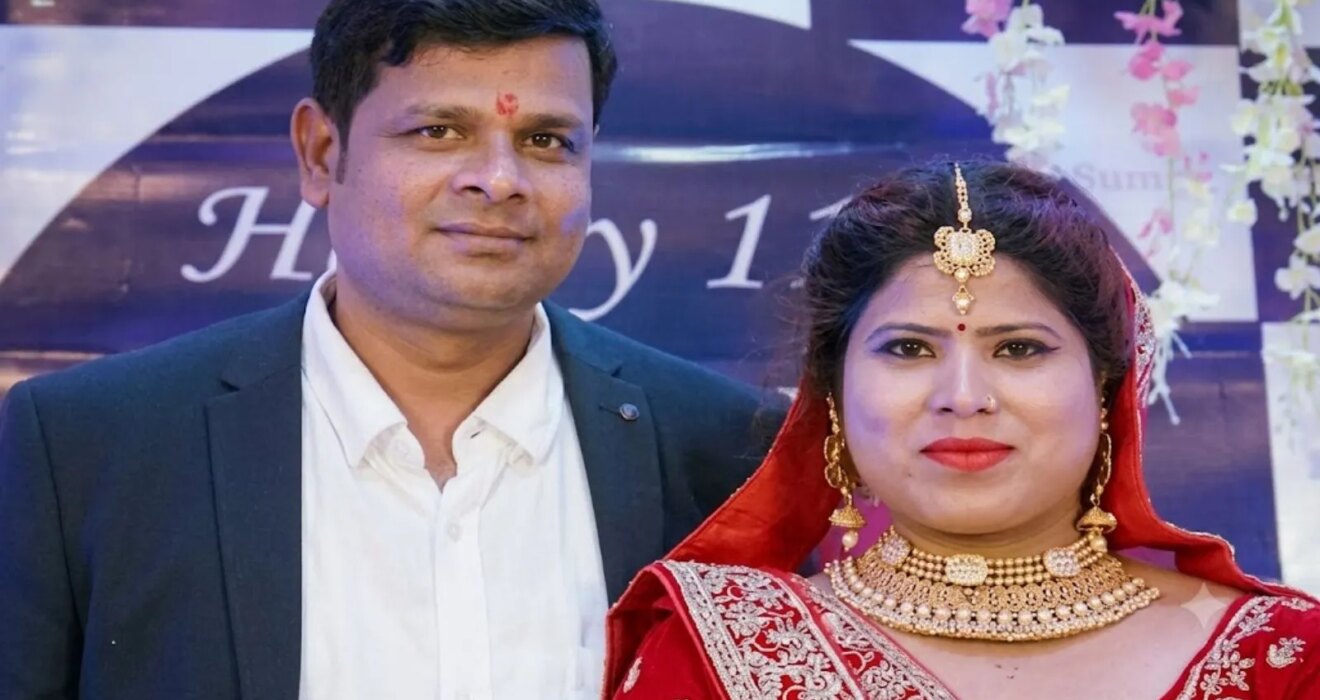
His wife, Suman Kumari, has been arrested in the current case for allegedly helping him evade arrest. She told police he had been acquitted in the murder case.
An officer drew a comparison with cybercrime. Just as Jamtara became a hub for phone fraud, certain areas are notorious for exam paper leaks, Samastipur in Bihar, Sonipat in Haryana, with gangs that include former coaching class teachers active for years.
A safeguard that became the weakness
The bitter irony of the case is that the Agra press was itself the security measure.
Before 2017, Maharashtra’s question papers were printed at such presses. From around 2017-18, a private agency finalised through tendering was entrusted with conducting multiple recruitment examinations. Then came the 2021 leak in the recruitment process for Health Department employees, a probe into which found the involvement of senior officials and the contracted agency itself. The state decided to reduce dependency on a single agency and returned to the traditional practice of secret out-of-state printing.
That very protocol is what Gupta’s model exploited. The system’s premise, that press employees in another state cannot read or care about the papers they handle, turned out to be no protection at all. Gupta’s men did not need to read Marathi. They only needed to hand over whatever came off the machines.
The state is now rethinking again. A committee headed by Chief Secretary Rajesh Aggarwal has been constituted to recommend changes to the examination system, particularly the TET. School Education Minister Dada Bhuse announced the committee in the Assembly while responding to questions on the leak. School Education Secretary Ranjit Singh Deol was unavailable for comment.
According to sources, the committee is examining several options, including a computer-based test similar to the format used by the Maharashtra CET Cell, which conducts admissions to professional courses in the state, and digital delivery of question papers, a system already followed by several universities.