
Computer Engineering emerges as India’s most popular branch: AISHE report | Education News
3 min readNew DelhiUpdated: Jul 10, 2026 07:07 PM IST
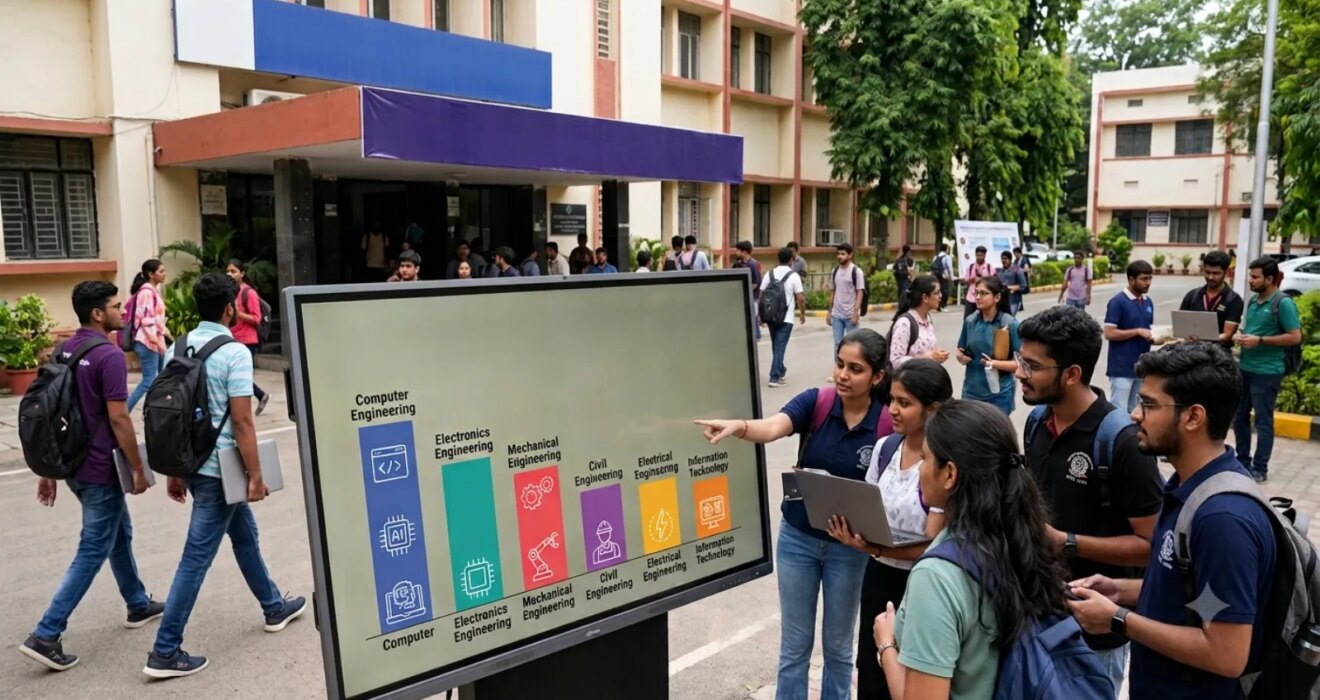
Computer Engineering has emerged as India’s most preferred engineering branch, recording the highest enrolment among all engineering specialisations, according to the latest All India Survey on Higher Education (AISHE) 2023–24. The trend highlights growing student interest in careers in software development, artificial intelligence (AI), and other digital technologies. Computer Engineering leads enrolment across engineering branches, followed by Electronics Engineering, Mechanical Engineering, Civil Engineering, Electrical Engineering, and Information Technology.
The report shows that Engineering and Technology enrolment across undergraduate, postgraduate, integrated, MPhil, and PhD programmes stands at 46,33,868 students.
Read | Private universities are growing three times faster than government ones
The trend is also reflected in graduate output. According to the report’s undergraduate pass-out data, Computer Engineering (CE) produced 2,62,408 graduates in 2023–24, accounting for nearly one in three of the 8,33,808 Engineering and Technology graduates. In comparison, Mechanical Engineering recorded 1,13,390 pass-outs, followed by Electronics Engineering (1,11,242), Civil Engineering (88,839), and Electrical Engineering (72,062).
The findings point to changing student preferences as India’s digital economy expands. While core engineering branches such as Mechanical, Civil, and Electrical Engineering continue to account for a significant share of enrolment and graduates, computing-related disciplines are attracting the largest number of students. At leading engineering institutions, including the IITs, NITs, and several state and private engineering colleges, Computer Science and allied branches have increasingly become the preferred choice among top-ranking candidates during admissions.
Engineering & Technology Enrolment by Major Discipline (AISHE 2023–24)
| Rank | Engineering discipline | Enrolment (Approx.) | Share of Engineering enrolment |
|---|---|---|---|
| 1 | Computer Engineering | 18,40,900 | 39.7% |
| 2 | Electronics Engineering | 5,70,400 | 12.3% |
| 3 | Mechanical Engineering | 4,44,200 | 9.6% |
| 4 | Civil Engineering | 3,60,300 | 7.8% |
| 5 | Electrical Engineering | 3,36,200 | 7.3% |
| 6 | Information Technology | 2,39,300 | 5.2% |
| 7 | Electronics & Communication Engineering | 79,400 | 1.7% |
| 8 | Architecture | 69,100 | 1.5% |
| 9 | Chemical Engineering | 58,500 | 1.3% |
| 10 | Artificial Intelligence & Machine Learning | 53,600 | 1.2% |
| 11 | Artificial Intelligence & Data Science | 51,600 | 1.1% |
| 12 | Agriculture Engineering | 24,000 | 0.5% |
The undergraduate enrolment analysis further shows that Engineering and Technology remains one of the largest professional streams in higher education, where over 8 lakh students pass out, with Computer Engineering attracting the biggest share of students within the discipline.
| Rank | Engineering Branch | UG Pass-outs | Share of Engineering UG Pass-outs |
|---|---|---|---|
| 1 | Computer | 2,62,408 | 31.5% |
| 2 | Mechanical | 1,13,390 | 13.6% |
| 3 | Electronics | 1,11,242 | 13.3% |
| 4 | Civil | 88,839 | 10.7% |
| 5 | Electrical | 72,062 | 8.6% |
The shift in higher education mirrors changes in the labour market. LinkedIn’s AI Labour Market Report 2026 found that India recorded the world’s fastest growth in AI engineering hiring, with AI hiring increasing 59.5 per cent year-on-year. Similarly, the World Economic Forum’s Future of Jobs Report 2025 identifies AI and Machine Learning Specialists, Big Data Specialists, and cybersecurity professionals among India’s fastest-growing occupations through 2030.
Story continues below this ad
The latest AISHE report also underscores the continued expansion of technical education. Overall higher education enrolment reached a record 4.5 crore students in 2023–24, while enrolment in science, technology, engineering and mathematics (STEM) disciplines crossed the one-crore mark, highlighting sustained demand for technical and professional education.